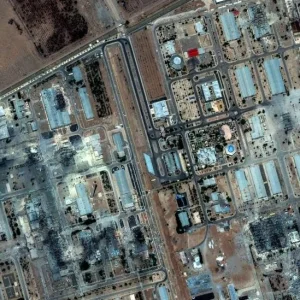
Following a recent Wall Street Journal bombshell that the Trump administration is contemplating a daring military raid to physically extract Iran's enriched uranium stockpile, defense experts are sounding the alarm over the astronomical risks involved.
While the White House maintains that no final decision has been reached, analysts warn that the logistical and tactical nightmares of such an operation are immense.
At the outbreak of the ongoing conflict, US officials estimated Iran held roughly 440 kilograms of uranium enriched to 60 percent—a threshold dangerously close to the 90 percent required for nuclear weapons. Additionally, Tehran reportedly possesses 1,000 kilograms enriched to 20 percent and another 8,500 kilograms at the 3.6 percent level traditionally used for medical research.
The primary hurdle is pinpointing the material's location. While the bulk of the near-weapons-grade uranium is thought to be housed in the underground Isfahan facility, significant quantities may have been scattered to other locations.
"The ideal scenario is that you know exactly where it is," noted Jason Campbell, a former defense official who served under both the Obama and Trump administrations. "If it's been dispersed to four different sites, then you're talking about a whole different level of complexity."
This intelligence gap widened significantly after the US-Israeli air campaigns of 2025, which targeted major nuclear sites including Isfahan, Fordo, and Natanz in an offensive dubbed Operation Midnight Hammer. Following the strikes, international inspectors were evacuated. Rafael Grossi, head of the International Atomic Energy Agency, recently admitted that without access, the exact distribution of the stockpile remains a mystery.
"There are many questions that we will only elucidate when we are able to go back," Grossi told reporters.
Even with precise intelligence, physical retrieval would be a monumental feat. Satellite imagery reveals that Tehran heavily fortified these underground bunkers ahead of recent bombardments, with Isfahan’s tunnel entrances seemingly sealed under mounds of earth and rubble. Because the uranium is stored in gaseous form within massive metal containers deep underground, heavy machinery would be required to excavate the sites.
While allied air superiority has successfully crippled Iran’s navy and ballistic missile infrastructure, seizing nuclear material demands boots on the ground. Military strategists suggest elements like the 82nd Airborne Division could be tasked with seizing a nearby airfield to establish an operating base, paving the way for Special Operations teams specifically trained in handling nuclear payloads.
"You've first got to excavate the site and detect [the enriched uranium] while likely being under near constant threat," Campbell explained.
The geographical hazards of such an insertion cannot be overstated. Isfahan sits roughly 300 miles inland, placing US ground forces deep within hostile territory.
According to Alex Plitsas, a former defense official and Middle East security expert, despite extensive efforts by the US and Israel to degrade Iranian defenses, it remains a profoundly high-risk mission. "It makes medical evacuations difficult given the distances. It makes US troops vulnerable to anti-aircraft fire coming in and out, as well as attacks while they're at the nuclear facility," Plitsas warned.
Once secured, commanders would face a critical choice: dilute the uranium on-site or fly it out. Early in the conflict, administration officials entertained the idea of on-site dilution. However, experts like Jonathan Ruhe of the Jewish Institute for National Security of America argue that direct extraction is the faster option, even if it carries unprecedented danger.
"You've got basically a half ton of what's effectively weapons grade uranium that you've got to extricate," Ruhe said. "And there are a million things that could go wrong."