The partial closure of the US government has officially shattered historical records, dragging into its 44th day on Sunday. The impasse stems from a bitter partisan dispute in Washington over funding for the Department of Homeland Security (DHS).
Surpassing the previous longest shutdown that ended in November 2025, the current funding lapse, which began on February 14, has triggered severe nationwide disruptions.
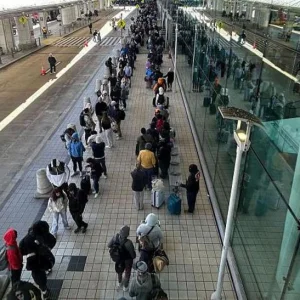
The most visible fallout has unfolded at airports across the country, where unpaid Transportation Security Administration (TSA) officers have been calling out sick or resigning. According to the DHS, approximately 500 officers have quit thus far, and over 3,500—roughly 12% of the workforce—called out absent on Friday alone. Social media has been flooded with viral footage of massive, wrapping security queues, sparking fears over the country's readiness to co-host the upcoming World Cup in June.
In an effort to mitigate the travel nightmare, President Donald Trump signed an executive order aimed at freeing up funds to pay TSA personnel early next week. Speaking from Air Force One on Sunday, Trump declared his willingness to pay the agents indefinitely, though he continued to pressure Congress for a permanent legislative solution. However, the legality of his executive action remains uncertain, as the US Constitution grants Congress the exclusive power of the purse.
White House border tsar Tom Homan confirmed that Immigration and Customs Enforcement (ICE) personnel, who were deployed to assist with airport operations, will remain stationed at security checkpoints to support TSA workers. Homan stressed that the length of the ICE deployment hinges entirely on how many TSA agents return to their posts once their paychecks resume.
Despite the escalating crisis, a swift resolution seems highly unlikely as Congress recently adjourned for a two-week recess without striking a deal.
The legislative stalemate centers on fundamental disagreements over immigration policy. While the Senate advanced a bipartisan compromise designed to partially fund the DHS and ease the airport crisis by excluding ICE funding, House Republicans immediately rejected it. Instead, the House advanced a short-term bill fully funding the department, arguing they will not support any legislation lacking funds for immigration enforcement and voter ID requirements. Senate Democrats have firmly opposed this counter-offer, demanding reforms such as prohibiting ICE agents from wearing masks and banning racial profiling.
With Trump doubling down on his assertion that ICE is crucial to the nation's well-being and blaming Democrats for the prolonged shutdown, lawmakers remain deadlocked, leaving thousands of federal workers and millions of travelers in continued limbo.