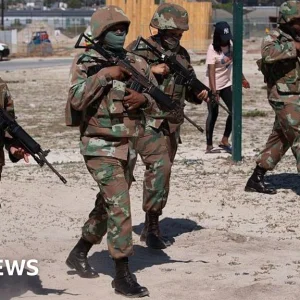
In a drastic bid to wrest control back from ruthless gangs and illegal mining syndicates, South Africa has mobilized its military, sending armed soldiers into some of the nation's most violent neighborhoods.
President Cyril Ramaphosa authorized the year-long deployment of 2,200 troops to reinforce an overwhelmed police force. The military presence spans five of the country’s nine provinces, targeting regions crippled by a staggering crime wave. South Africa currently grapples with one of the highest murder rates globally, with recent official statistics revealing an average of 71 killings every single day.
The phased rollout began in March with an initial detachment entering Gauteng province, which encompasses Johannesburg. Starting April 1, the main contingent expands its operations into the Eastern Cape, Free State, North West, and Western Cape provinces.
Despite the formidable show of force, the military’s arrival has been met with mixed emotions on the ground. In Eldorado Park, a Johannesburg suburb notorious for brutal gang warfare, residents are deeply divided on whether the troops will bring salvation or more bloodshed.
"Sodom and Gomorra have nothing on this place," said 74-year-old pensioner Leola Davies, who described her neighborhood as a hellscape where paralyzing fear keeps her permanently locked indoors.
While some locals appreciate the temporary security the military patrols provide, they remain acutely aware of its fleeting nature. Ronald Rabie, a 56-year-old father, noted that while the streets briefly feel safer for families, the peace is an illusion. "Once they leave, things return to chaos—they need to be here permanently," he said. Conversely, others fear the heavy-handed presence will only fan the flames of neighborhood violence.
Security experts and criminologists echo these civilian concerns, warning that soldiers are fundamentally trained for maximum-force warfare, not the nuanced community policing required to dismantle entrenched gangs. Under South African law, military personnel possess severely limited powers to arrest civilians and must promptly hand any suspects over to local law enforcement.
Criminologist Guy Lamb cautioned against using combat troops in civilian arenas, noting a high risk of aggressive escalation in already tense environments. This apprehension is deeply rooted in the nation's dark history; the apartheid regime routinely weaponized the military to enforce its racist rule and suppress dissent. Even more recently, during the COVID-19 pandemic, military units deployed to enforce curfews faced fierce backlash over reports of excessive force, harassment, and unlawful detentions.
This latest operation marks another chapter in the government's increasing reliance on the army to maintain domestic order. Ramaphosa previously deployed troops in 2021 to quell deadly riots following the arrest of former President Jacob Zuma, and again in 2023 to combat illicit gold mining operations.
Yet, critics argue that a military occupation is merely a temporary patch over a gaping wound. Experts warn that unless the government urgently addresses the deep socio-economic fractures and root causes driving the bloodshed, the violence will inevitably resurge the moment the soldiers retreat to their barracks.