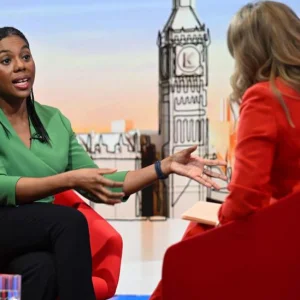
As geopolitical tensions threaten to send utility costs soaring, Conservative Party leader Kemi Badenoch is pressing the UK government to prioritize slashing taxes on energy bills before resorting to direct financial bailouts for households.
Speaking in a weekend broadcast interview, Badenoch cautioned that issuing direct government checks to consumers ultimately exacts a heavy toll on the economy, often resulting in broader tax hikes down the line. While she stopped short of completely ruling out direct financial aid if energy prices spiral out of control, she firmly advocated for stripping taxes and environmental levies off bills as the best first line of defense.
The debate over government intervention arrives amid mounting fears of an impending energy crisis. Wholesale gas and oil prices have surged following Iran’s effective blockade of the Strait of Hormuz—a crucial artery for global oil shipping—driven by the escalating conflict in the Middle East. Although UK consumers will see a brief reprieve when the energy regulator lowers the price cap this April, industry forecasts warn of a sharp price escalation in the subsequent months.
"Let's not pretend that these huge bailouts don't come with a cost," Badenoch stated. She pointed to the lasting economic hangovers and interest rate shocks that followed massive government borrowing during the COVID-19 pandemic. Badenoch criticized the current Labour administration for appearing to focus its protective measures solely on welfare recipients, arguing that eliminating initiatives like the Carbon Tax and Renewable Obligations Certificate would alleviate the financial strain on the wider public.
Chancellor Rachel Reeves recently outlined Labour’s contrasting approach, confirming that any forthcoming financial safety net will be strictly reserved for "those who need it most." Reeves emphasized the absolute necessity of adhering to strict borrowing limits to keep inflation and interest rates in check. Labour Party chairwoman Anna Turley quickly dismissed Badenoch's proposal, claiming her tax-cut strategy lacks targeted support and would fail to deliver meaningful relief to struggling families.
Across the political spectrum, rival parties are pitching competing solutions. The Liberal Democrats are pushing for universal government assistance, warning that millions of middle-income families who do not qualify for state benefits are being left to face the cost-of-living crisis alone. Meanwhile, the Green Party has demanded a total freeze ahead of the anticipated price cap update in July.
Right-wing rival Reform UK echoed the call to eliminate VAT and environmental levies on energy but delivered a scathing critique of Badenoch's party. Reform's Zia Yusuf branded the Conservatives as "shameless arsonists offering to rebuild your home having spent 14 years burning it to the ground," pointing out that previous Tory administrations were responsible for introducing the very green levies and North Sea taxes they now pledge to abolish.
Beyond immediate consumer relief, the Conservatives are heavily pushing for a return to domestic fossil fuel reliance, demanding maximized North Sea oil and gas extraction alongside an end to corporate windfall taxes. Badenoch argued that the resulting industry profits and tax revenues could eventually be used to subsidize household energy costs.
The Labour government, however, maintains its ban on new North Sea drilling licenses. Education Secretary Bridget Phillipson defended the current strategy as "pragmatic," insisting that the UK must end its reliance on volatile fossil fuel markets and commit to investing heavily in home-grown renewable energy.