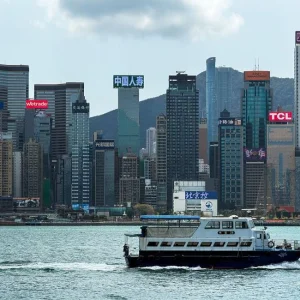
A sleek delivery robot idles in a bustling Hong Kong hotel lobby, waiting patiently for elevator doors to open before smoothly rolling inside to complete its delivery. While the maneuver appears simple, it represents a calculated geopolitical strategy. The robot's creator, mainland Chinese tech firm Yunji, is using Hong Kong's unique commercial environment as a staging ground to launch its ambitious global expansion.
"We aim to make our product succeed in Hong Kong, and then expand outward," explains Xie Yunpeng, Yunji's vice-president.
Yunji is part of a growing wave of mainland technology enterprises pivoting to the special administrative region. For these companies, Hong Kong has evolved into an essential hub to secure capital, beta-test products on international clients, and build much-needed credibility.
The pivot comes as Western markets increasingly view Chinese tech ventures through the lens of "China risk." Driven by fears of state-sponsored espionage and market monopolization, the United States and European nations have erected formidable barriers against Chinese technology. With direct access to foreign capital and customer trust heavily restricted, mainland innovators are seeking refuge in Hong Kong.
The financial data reflects this shift. According to PricewaterhouseCoopers, the number of mainland firms listing on the Hong Kong Stock Exchange skyrocketed to 76 last year, a massive 153% jump. Invest Hong Kong, the city's investment promotion agency, also notes a sharp increase in mainland tech and innovation firms setting up shop.
Xiaomeng Lu, a director at the Eurasia Group, notes that geopolitical headwinds have dashed many mainland companies' hopes of floating on the New York Stock Exchange. "These days Hong Kong is their best hope to attract global investors and position themselves as a player not fully constrained by the boundary of the mainland market," she observes.
Similarly, Wendy Chang of the Mercator Institute for China Studies describes Hong Kong as a critical "connector to the outside world," bolstered by aggressive local policies designed to fast-track share flotations and streamline business operations.
This corporate migration aligns seamlessly with Beijing's aggressive push toward "technology self-reliance." As outlined in China's new 15th Five-Year Plan, reducing dependence on foreign software and hardware—particularly in artificial intelligence and semiconductors—is a top strategic priority. Consequently, experts like DGA Group partner Paul Triolo see Hong Kong functioning as a highly valuable "halfway house" for high-tech mainland enterprises.
Beyond capital, Hong Kong offers a sandbox for regulatory and operational compliance. Alicia Garcia-Herrero, chief economist for Asia-Pacific at Natixis, points out that the city allows Chinese firms to prove their adherence to rigorous international standards. For example, AI software developer MiningLamp Technology established a Hong Kong base recently to act as a "data compliance transfer station." According to founder Wu Minghui, the city provides the perfect environment to navigate complex cross-border data regulations before entering tougher Western markets.
Yet, setting up in Hong Kong is not a silver bullet. Western governments continue to intensify national security reviews of Chinese investments, particularly concerning critical infrastructure and data access. High-profile bans on Chinese telecom suppliers in the US and UK illustrate the enduring skepticism.
Furthermore, international investors remain cautious regarding corporate governance, with memories of scandals like the 2020 Luckin Coffee fabricated sales debacle still lingering.
Hong Kong itself also faces its own reputational challenges. The city's allure to international investors has noticeably dimmed following the mass pro-democracy protests of 2019 and the subsequent implementation of sweeping national security laws. Despite these local hurdles, for China's ambitious tech sector, the city currently remains the most viable gateway to the rest of the world.