Faced with new energy shock, Europe asks if reviving nuclear is the answer
News
Business
Technology
Culture
Arts
Travel
Earth
Audio
Video
Live
Documentaries
Faced with new energy shock, Europe asks if reviving nuclear is the answer
2 hours ago
Share Save
Katya Adler Europe Editor

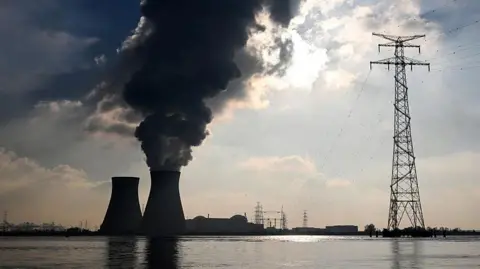 AFP via Getty Images
Belgium is one of a number of European countries revising their nuclear strategy
With a pit in their stomach, families and industries across Europe are watching gas prices and the cost of filling vehicles with petrol spiral.
While the UK government has told voters pretty much to keep calm and carry on, the European Commission - the EU's executive arm - has called on people to work more from home and to travel a lot less.
Policymakers warn things could get much worse - depending on what happens next in the Middle East. Yet it feels like only yesterday that Europeans faced a cost-of-living crisis on the back of spiralling energy costs and inflation following Russia's full-scale invasion of Ukraine.
This means conversations in Europe are turning (again) to the issue of energy independence.
And nuclear energy seems to be back in fashion as part of a home-grown European energy mix - in the UK as well as the EU. But how quick a fix can nuclear be - and how safe and reliable is it really?
 AFP
AFP
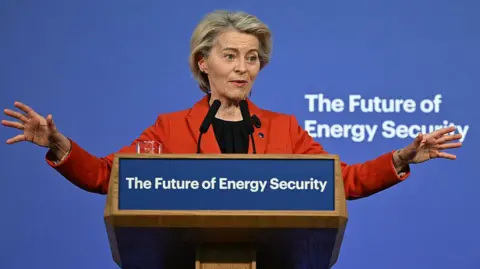
European Commission President Ursula von der Leyen said the war had exposed the continent's fossil-fuel "vulnerability"
At the recent European Nuclear Energy Summit in Paris, European Commission chief Ursula von der Leyen, who perhaps forgot she was a minister in the German government when it took the decision to phase out nuclear power plants in 2011, described Europe broadly turning its back on nuclear as a "strategic mistake".
In 1990, Europe produced around a third of its electricity from nuclear power. That has now fallen to an average of 15%, leaving the continent "completely dependent on expensive and volatile imports" of fossil fuels, she said, putting Europe at a disadvantage compared with other regions of the world.
Europe imports more than 50% of its energy. Mainly oil and gas.
This leaves the continent vulnerable to unexpected reductions in supply, as was the case with Russia after Europe imposed energy export sanctions, or price increases on the global market, as we are now seeing because of Iran's strangling of energy exports via the Strait of Hormuz.
Gas prices rise at a similar rate across Europe but the impact on electricity prices varies depending on each country's energy mix.
In Spain - which has invested heavily in wind and solar power - the average electricity price for the rest of 2026 is forecast at around half of Italy's, where gas sets the electricity price 90% of the time.
France is Europe's largest nuclear producer. It generates about 65% of its electricity from nuclear power. Based on futures contracts, German electricity prices for next month are five times those of France - an eye-watering contrast.
Germany phased out nuclear power following the 2011 Fukushima nuclear disaster in Japan. This left the energy-hungry industries that traditionally power the German economy - cars and chemicals - hugely gas-dependent.
This week, Berlin's top economic research institutes more than halved their growth forecasts for 2026 to a predicted 0.6% of GDP because of global price hikes for gas.
A renewed enthusiasm for nuclear power is palpable in Europe:
- Italy is preparing draft laws to repeal its longstanding ban
- Belgium seems to be making a complete U-turn after years of reluctance about investing in nuclear energy
- Greece, historically cautious because of seismic concerns, has opened a public debate on advanced reactor designs
- Sweden reversed a four-decade old decision to abandon nuclear technology
- In the UK, Chancellor Rachel Reeves recently announced streamlining regulation to help advance nuclear projects.
"To build national resilience, drive energy security and deliver economic growth, we need nuclear," said Reeves.
New polling from YouGov suggests growing support for nuclear energy in Scotland, with the majority of people now backing it as part of the country's energy supply.
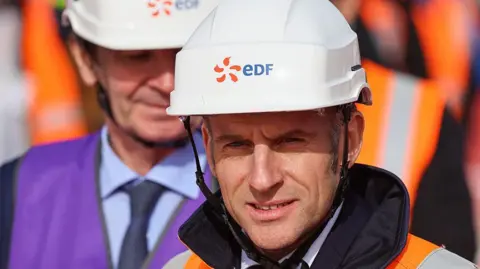
No prizes for guessing that France is the loudest nuclear cheerleader. President Emmanuel Macron is ever eager to point to the industry's credentials as a low carbon-emitter, potentially helping the EU towards its net zero goals.
He told Europe's nuclear summit that "nuclear power is key to reconciling both independence, and thus energy sovereignty, with decarbonisation, and thus carbon neutrality".
 AFP
AFP
France's Emmanuel Macron has long backed his country's nuclear energy industry
He also emphasised the increased energy demand from AI and his belief that nuclear power could give Europe a competitive edge or "the ability to open data centres, to build computing capacity and to be at the heart of the artificial intelligence challenge."
Until last year, Germany blocked efforts to treat nuclear energy on a par with renewables in EU legislation. That caused a lot of friction with Berlin's supposed closest EU friend, France.
But Berlin has since agreed to the removal of anti-nuclear bias. A cynic might say that could have something to do with defence and security concerns, provoked by deteriorating relations with the Trump administration.
Germany has asked France to extend its independent nuclear deterrent to European partners, something France agreed to this month.
But beware of viewing nuclear as an energy panacea.
Nuclear development is a long-term project, not a short-term fix to current energy insecurity.
Building nuclear reactors can be subject to extremely long delays, as recent examples in France and the UK have illustrated, at Flamanville-3 and Hinkley Point C.
Waste management and public concerns regarding the safety of nuclear energy persist.
 Anadolu via Getty Images
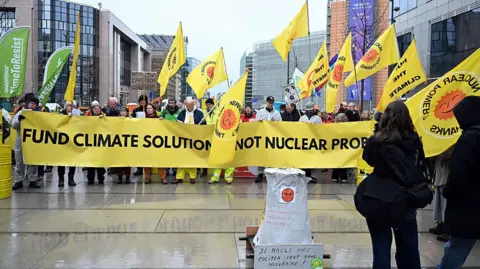
Anti-nuclear demonstrators last month marked the 15th anniversary of the Fukushima nuclear disaster
Environmental groups warn investment in nuclear energy can divert funds and political attention from speeding up the development of renewables, and an added layer of strategic risk is that a number of Central European countries, especially Hungary and Slovakia, still depend on Russian nuclear technology and uranium.
"You're ignoring the history of nuclear in Europe if you think it can just slot in [as an easy energy crisis solution]," Chris Aylett told me. He's a Research Fellow at the Environment and Society Centre, Chatham House.
Nuclear energy is part of the solution, he believes, but many European nuclear reactors are old and governments need to invest considerably just to maintain or extend their working life.
"The main challenge is maintaining existing share [of nuclear power]. If governments really want to increase the share, they need a lot of time and a lot of money."
But many of Europe's governments are indebted, cash-strapped and faced with numerous, competing priorities - such as how to maintain welfare and boost defence spending to the levels promised to US President Donald Trump.
Nuclear is also being beaten on price as the costs of wind and solar have gone down, Aylett points out.
So, with price and practicality in mind, the European Commission has rushed to embrace the concept of small modular reactors (SMRs).
SMRs are viewed as more cost-effective sources of nuclear power. They can be mass factory-produced and are particularly well-suited to meeting the energy demands of AI data centres, the production of hydrogen and local heating networks.
A €330m (£288m; $381m) EU nuclear energy investment package has just been unveiled, with strong support for SMRs. Brussels hopes to bring the up and coming technology online by the early 2030s.
The focus on SMRs is international. Last week, the US and Japan announced a $40bn project to develop SMRs in Tennessee and Alabama, while last month Emma Reynolds, the environment secretary, published the regulatory justification for Rolls-Royce's plan to become the first company to try to build SMRs in the UK.
But as attractive as they sound, SMRs are viewed as unproven at commercial scale. As of early 2026, no construction licences had been granted anywhere in the EU.
Nuclear fusion research is also benefiting from EU attention, though. The EU aims to develop the first commercial fusion power plant online.
But for now, most in Europe still rely on fossil fuel imports.
It is plainly in the continent's interest to be more energy independent, Aylett argues, so as not to be exposed to the whims of exporters including erratic authoritarians, or algorithms in oil and gas commodity markets.
European governments clearly see nuclear as part of the medium to long-term solution. But what of the here and now?
## The nuclear power station at the centre of the political divide in Scotland
## Moment cooling tower is demolished at German power plant
## Germans split as last nuclear plants are shut down
Related
## What's next for defunct nuclear site Hinkley A?
## Nuclear plant told to improve after 'near misses'
## Next stage for nuclear and clean energy site
More from the BBC
 ## After 16 years in power, can Viktor Orban finally be unseated? Hungary is going to the polls in nine days - after 16 years in power, can Viktor Orban be unseated? 2 hrs ago
 ## Why did US and Israel attack Iran and how long could the war last? Conflict has spread across the Middle East since the US and Israel launched strikes on Iran on 28 February. 4 hrs ago
 ## How elite US teams tackle combat rescue missions Air force pararescue units who specialise in CSAR missions are among the most highly trained in the US military. 4 hrs ago
 ## US warns its citizens to leave Lebanon citing escalating security risks The advisory follows recent military developments, including a US jet reportedly being shot down and Israeli strikes on parts of Beirut. 5 hrs ago
 ## Experts dispute US account of deadly Iran sports hall strike in Lamerd Six weapons experts have contested the US claim that video evidence suggests an Iranian missile could have hit the hall. 12 hrs ago
- Home
- News
- Sport
- Business
- Technology
- Health
- Culture
- Arts
- Travel
- Earth
- Audio
- Video
- Live
- Documentaries
- Weather
- BBC Shop
- BritBox
BBC in other languages
The BBC is in multiple languages
Read the BBC In your own language
Noticias para hispanoparlantes
Follow BBC on:
- Terms of Use
- Subscription Terms
- About the BBC
- Privacy Policy
- Cookies
- Accessibility Help
- Contact the BBC
- Advertise with us
- Do not share or sell my info
- BBC.com Help & FAQs
- Content Index
- Set Preferred Source
Copyright 2026 BBC. All rights reserved. The BBC is not responsible for the content of external sites.Read about our approach to external linking.