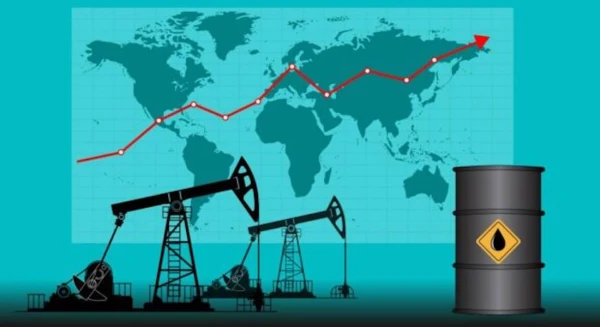
Oil prices surged while global stock markets faltered on Thursday as a nascent ceasefire between the United States and Iran showed immediate signs of strain, raising fears of renewed hostilities and supply disruptions.
Markets had rallied sharply the previous day after U.S. President Donald Trump announced a two-week halt in the conflict, with Iran agreeing to reopen the vital Strait of Hormuz for peace talks. However, optimism quickly evaporated as Israel continued major bombardments in Lebanon, targeting Iran-backed Hezbollah forces.
Iranian officials declared that Israel's actions violated the ceasefire terms, leading to reports that the Strait of Hormuz—a critical passageway for approximately one-fifth of the world's oil and gas—was once again closed. Tehran cited the risk of sea mines while announcing alternative shipping routes.
"If Iran wants to let this negotiation fall apart… over Lebanon, which has nothing to do with them, and which the United States never once said was part of the ceasefire, that's ultimately their choice," said U.S. Vice President JD Vance.
Iranian Parliament Speaker Mohammad Bagher Ghalibaf stated on social media that the "workable basis on which to negotiate" had been violated, listing continued attacks in Lebanon, a drone incursion into Iranian airspace, and a denial of Iran's uranium enrichment rights as breaches by the U.S.
In response to the escalating tensions, both major crude oil benchmarks climbed more than 3%, erasing the previous day's steep losses. Equity markets across Asia and Europe retreated, with Tokyo, Hong Kong, Shanghai, Singapore, Seoul, and Mumbai all posting losses. London, Paris, and Frankfurt opened lower, while U.S. stock futures also pointed downward.
Attention now turns to impending diplomatic talks in Pakistan, where a U.S. delegation led by Vice President Vance is expected to engage with Iranian officials. The discussions will center on a contentious 10-point plan from Tehran, which reportedly includes demands for Iranian control of the Strait of Hormuz, U.S. acceptance of Iran's uranium enrichment program, the lifting of all sanctions, and a withdrawal of U.S. military forces from the region.
United Nations Secretary-General Antonio Guterres warned that Israel's strikes in Lebanon posed a "grave risk" to the fragile truce, underscoring the high stakes for global stability and energy markets.