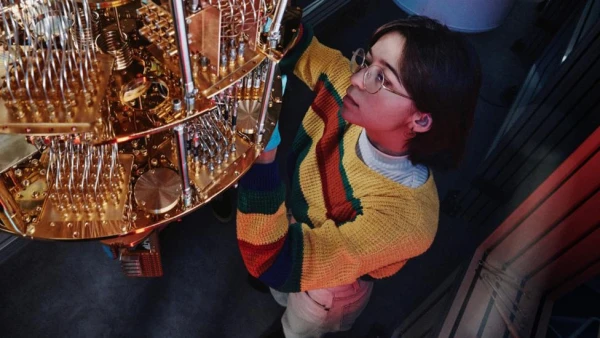
In a Parisian laboratory where cherry trees bloom along the Seine, technicians are fine-tuning machines that operate at temperatures colder than deep space. These intricate devices—cryostats that chill to minus 273 degrees Celsius—house quantum computers, representing Europe's bold bid to lead the next computing revolution.
At the heart of this effort is French startup Alice & Bob, where co-founder Théau Peronnin explains the transformative potential. "Quantum computing isn't about incremental speed improvements," he says. "It's about solving problems that are absolutely intractable with classical computers—potentially making medicine an exact science by simulating molecular interactions that currently require years of trial and error."
The global race centers on overcoming quantum computing's fundamental challenge: qubit fragility. Most approaches use thousands of physical qubits per logical one, creating massive redundancy to correct errors. Alice & Bob has pioneered a different path with "cat qubits"—named after Schrödinger's famous thought experiment—that autonomously correct errors through design rather than redundancy.
"We've cracked a way to compensate for losses continuously," Peronnin notes. "This dramatically reduces complexity and cost compared to our competitors." The company's approach has attracted attention as major players like Google pursue similar strategies, with Peronnin claiming they now stand "shoulder to shoulder" with U.S. competitors.
France's quantum ecosystem extends beyond Alice & Bob, with six established companies and two more in development covering the full spectrum of qubit technologies. According to quantum technology expert Olivier Ezratty, these firms share a crucial advantage: "Most are in a very favorable position regarding both machine cost and energy consumption."
Across Europe, Finland's IQM recently announced plans to become the continent's first listed quantum company, while the UK hosts Oxford Quantum Circuits and Riverlane. Several European quantum computers are already integrated into high-performance computing installations, with French systems operating in companies like industrial giant Air Liquide.
As Alice & Bob prepares to open a $50 million facility north of Paris with testing capabilities and a clean room for chip production, Peronnin sees the stakes clearly: "The prize for building the first reliable quantum computer at scale is potentially enormous—it will be winner-takes-all, just as it was with classical computers and IBM." With their innovative approach and growing ecosystem, European quantum pioneers believe they have more than a fighting chance to claim that prize.