Before the summer of 1970, resolving a deadlocked football match often relied on pure, unadulterated chance. Teams were subjected to grueling replays, the flip of a coin, or even drawing lots. Famously, Italy advanced to the 1968 European Championship final simply by winning a coin toss against the Soviet Union.
The breaking point for the sport's lawmakers arrived later that year at the 1968 Olympics. Following a 1-1 quarter-final draw against Bulgaria, Israel's captain was forced to pull a slip of paper from a sombrero. The paper coldly read 'no', instantly eliminating the Israeli squad. Outraged by a system dictated entirely by luck, Israeli Football Association official Yosef Dagan demanded a method rooted in athletic skill.
Collaborating with Michael Almog, who would later head the Israel FA, Dagan conceptualized the penalty shootout. In 1969, they submitted a formal proposal to FIFA.
Almog passionately argued that drawing lots was "an immoral and even cruel system for the losing team and not honourable for the winner."
He outlined a format where each team would take five penalties, moving to sudden death if the score remained tied. After heavy debate, the International Football Association Board (IFAB) officially enshrined the rule on June 27, 1970.
The world didn't have to wait long to witness the new format's dramatic potential. Its inaugural outing came during a pre-season Watney Cup match, pitting massive underdogs Hull City against a legendary Manchester United squad featuring George Best, Bobby Charlton, and Denis Law.
After Hull's Chris Chilton and United's Denis Law both found the net, the match finished 1-1 and progressed through extra time. As the final whistle blew, a hushed anticipation fell over the stadium. Players quickly realized they were stepping into uncharted territory.
Manchester United's George Best etched his name into the history books by calmly converting the first-ever shootout penalty. Hull's Terry Neill answered, becoming the first player-manager to score in the format.
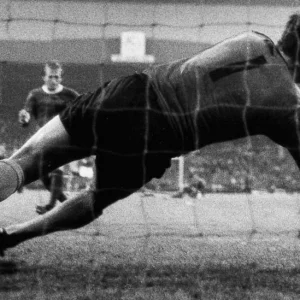
However, the enduring legacy of the shootout has always been the sheer agony of the miss. Denis Law suffered the unfortunate distinction of becoming the first player denied in a shootout, thwarted by a spectacular diving save from Hull goalkeeper Ian McKechnie.
Yet, McKechnie's heroic narrative violently pivoted. With Hull trailing and needing a goal to stay alive, the goalkeeper himself stepped up to the spot. He blasted a powerful strike, but the ball violently ricocheted off the upper crossbar. With that singular strike, McKechnie became both the first goalkeeper to save a penalty and the first to miss one, sealing Hull's defeat.
Since that fateful evening, the penalty shootout has become football's ultimate crucible. With statisticians noting a historical 24% miss rate, the format has decided countless major tournaments, including three Men's World Cup finals.
While the shootout successfully eradicated the absurdity of the coin toss, the excruciating tension it produces remains unmatched. More than half a century after its invention, the penalty shootout proves that while football found a more logical way to break a tie, it never truly cured the cruelty of defeat.