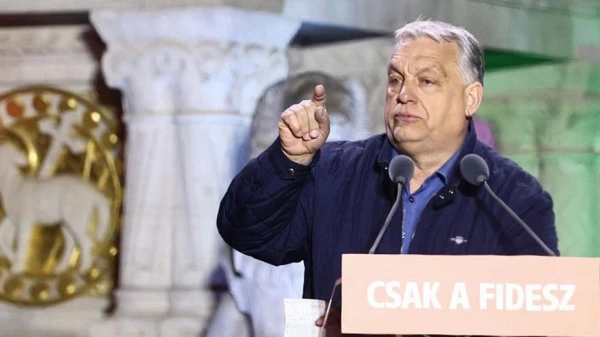
Hungarians are heading to the polls in a pivotal election that could mark the end of Prime Minister Viktor Orbán's 16-year tenure, with opposition leader Péter Magyar mounting a formidable challenge that has captured the nation's attention.
Voting commenced early Sunday morning, with results expected to unfold throughout the evening. Most pre-election surveys indicate a significant lead for Magyar's Tisza party, which emerged as a grassroots movement after Magyar's departure from Orbán's ruling Fidesz party. The outcome carries profound implications not only for Hungary but for European politics and international relations.
Addressing supporters on the eve of the election, Orbán projected confidence despite the polling trends. "We are going to achieve such a victory that will surprise everyone, perhaps even ourselves," he declared to thousands gathered in Budapest's Castle Hill square. The prime minister maintained his familiar campaign rhetoric, focusing criticism on the European Union and Ukraine while emphasizing national sovereignty.
Magyar, meanwhile, urged voters to resist what he described as "Fidesz pressure and blackmail" and called for a fundamental shift in Hungary's political direction. His final rally in Debrecen reportedly drew larger crowds than Orbán's Budapest event, signaling growing momentum for the opposition.
"After 16 years of what the European Parliament has termed a 'hybrid regime of electoral autocracy,' we are promising a change of regime, a reset of relations with the European Union, and an end to close relations with Russia," Magyar has emphasized throughout his campaign.
Orbán's government has faced mounting challenges in recent years, including economic struggles and a series of political scandals. Revelations that Hungary's foreign minister regularly communicated with his Russian counterpart before and after EU summits have drawn particular scrutiny. Additionally, Orbán's veto of substantial EU aid to Ukraine has strained relations with European partners.
Election specialist Róbert László of Budapest's Political Capital think tank notes that most reliable pollsters show a "huge lead" for Tisza. "The most likely scenario is that Tisza will have a comfortable, absolute majority, but not a two-thirds majority," László explains. "But you can't exclude a two-thirds majority either."
Hungary's complex electoral system adds layers of uncertainty to the outcome. Of the 199 parliamentary seats, 106 are directly elected in constituencies while 93 are allocated through party lists that include votes from Hungarians abroad. The transfer of votes from losing parties and excess votes from winning parties has historically benefited Fidesz.
The campaign has revealed deepening societal divisions. In Györ, Hungary's sixth-largest city, Orbán faced vocal protests during a recent appearance, accusing demonstrators of "pushing Ukrainian interests." Magyar subsequently drew large crowds in the same city, where 20-year-old student Gergely Németh expressed the sentiment of many young voters: "All the young people I know want Fidesz out."
International attention has focused on the election, with former U.S. President Donald Trump publicly endorsing Orbán as his "true friend, fighter, and WINNER" and encouraging Hungarians to support him. This external endorsement contrasts with growing domestic dissatisfaction, particularly among younger voters and those affected by economic challenges.
As Hungarians cast their ballots, the nation stands at a crossroads between continuity under Europe's longest-serving prime minister and a promised transformation under new leadership. The results will determine not only Hungary's domestic policies but its position within the European Union and on the global stage.