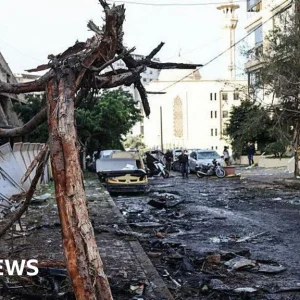
Israel has significantly escalated its military campaign in Lebanon, launching unannounced airstrikes on areas well outside Hezbollah’s traditional strongholds, including central Beirut and a predominantly Christian neighborhood to the north.
The broadened offensive saw a vehicle targeted in the residential Mansourieh district, while sudden nighttime explosions rocked the Jnah neighborhood in the heart of the Lebanese capital. According to the Lebanese Health Ministry, Al-Zahraa Hospital in Jnah received multiple casualties from the midnight strikes, which left displaced residents sleeping out in the open streets in sheer panic.
The Israeli military maintains that these expanded operations targeted Hezbollah infrastructure, claiming to have eliminated a top commander and another senior figure from the Iran-backed militant group.
Meanwhile, bombardment continues relentlessly in Hezbollah-dominated areas. The Dahieh district in Beirut's southern suburbs remains a primary target, with a building on the main airport road leveled following a sudden evacuation order. In southern Lebanon, an Israeli strike on a medical facility claimed the life of a paramedic, raising the total number of healthcare workers killed since the conflict began to 53.
The deepening crisis has prompted the Lebanese Armed Forces to abandon their final outposts in the south, withdrawing from the villages of Ain Ibel and Rmeish after an Israeli airstrike killed a Lebanese soldier. Despite the military retreat, some locals are stubbornly refusing to abandon their homes. In a widely circulated video, Father Najib Al Amil of the Christian village of Rmeish declared his resolve:
"There is grass and soil. We rely on God and will stay in our village. We either all die together and lose our land or live and our villages will live with us."
The ground reality is rapidly shifting as Israel signals long-term territorial ambitions. Israeli Defense Minister Israel Katz announced controversial plans to establish a permanent security buffer zone extending up to the Litani River—roughly 30 kilometers into Lebanese territory. Katz stated that Israel intends to maintain security control over the region indefinitely, a strategy that has drawn sharp criticism from the United Nations.
Katz declared that more than 600,000 displaced Lebanese residents would be "completely prohibited" from returning to the area until the safety of northern Israel is fully guaranteed. He added that border villages would face systematic destruction, explicitly comparing the planned demolition to the devastation seen in Gaza's Rafah and Beit Hanoun.
The escalating violence has taken a severe human toll. Lebanon’s Health Ministry reports 1,268 fatalities since the offensive began, while the UN estimates that over a million people have been displaced. Israeli strikes have also aggressively targeted bridges and supply lines, effectively severing the south and rendering much of it uninhabitable.
For many Lebanese, the current military strategy evokes painful memories of Israel's 18-year occupation of southern Lebanon from 1982 to 2000. Observers warn that while Israel possesses overwhelming aerial superiority capable of devastating the region's infrastructure, an extended ground occupation would likely plunge Israeli forces into a grueling guerrilla war against entrenched Hezbollah fighters. For the hundreds of thousands of Lebanese civilians driven from their homes, the prospect of a swift return appears increasingly bleak.