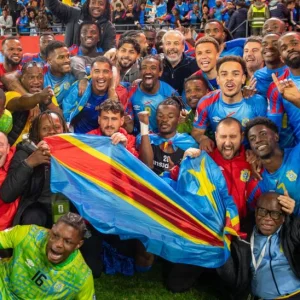
The Democratic Republic of Congo is on the precipice of footballing history. For 52 years, fans of the Leopards have waited to erase the bitter memories of their solitary, infamous World Cup appearance. Now, a victory over Jamaica in Tuesday's intercontinental play-off final in Mexico will secure their ticket to the upcoming global tournament, making them Africa's 10th representative.
"I'd definitely consider it as the biggest game in my football career," Burnley's Axel Tuanzebe noted, echoing the sentiments of former DR Congo captain Gabriel Zakuani, who flatly described the impending clash as "the biggest game in our history."
If the Leopards triumph, an estimated 110 million Congolese citizens and a passionate global diaspora will be hoping for a much better showing than the nation's 1974 campaign in West Germany. Playing under the name Zaire, that tournament was a disaster. After a 2-0 opening loss to Scotland, the team suffered a crushing 9-0 defeat to Yugoslavia.
However, it was a bizarre moment during a 3-0 loss to Brazil that permanently etched the team into World Cup lore. Defender Mwepu Ilunga famously sprinted out of the defensive wall to boot the ball away before Brazil could even take their free-kick. The incident sparked global mockery and damaged the reputation of African football, though later reports suggested the team's unraveling was tied to unpaid bonuses and severe threats from the authoritarian regime of President Mobutu Sese Seko.
"We were not a bad team," recalled Mohamed Kalambay, a goalkeeper from the 1974 squad, in a recent interview. "When you look at the teams in Africa, there are just a few that have been to the World Cup, but we were there and we deserved it."
Today's generation is eager to banish those ghosts. Zakuani, now an assistant coach for the Under-20 side, insists the goal isn't just to make up the numbers. "The aim is to also compete and put on a good show... not just be happy to be part of the party, but also to create history," he said.
Since their 1974 zenith, DR Congo has watched from the sidelines as other African nations like Senegal, Ghana, and Tunisia thrived. A vast, resource-rich country, DR Congo's sporting potential has been severely handicapped by decades of political instability, corruption, and devastating conflicts that have claimed millions of lives.
The scars of war are still fresh. In the eastern regions, rebel groups like M23 control major cities such as Bukavu and Goma. The national team used their platform during the 2023 Africa Cup of Nations to plead for peace, posing during the anthem with one hand covering their mouths and two fingers to their temples like a gun. Forward Yoane Wissa noted at the time that he hoped their tournament run allowed those affected to "smile a bit," while Tuanzebe described the sport as a "breath of fresh air" for the war-torn nation.
Yet, even celebrating the team comes with severe risks. Freddy, a fan based in Bukavu, explained that the late-night kick-off times make watching the game at local bars a life-threatening endeavor.
"Whenever someone moves out late in the night, automatically he must be killed. Our area here in Bukavu is really dangerous due to the rebel occupation," he revealed.
To reach this crucial juncture, the Leopards have relied heavily on recruiting talent from the Congolese diaspora. Having finished second in their qualifying group behind Senegal, DR Congo navigated a grueling four-team African play-off, ultimately defeating Nigeria on penalties.
The squad's makeup reflects the nation's fractured domestic sporting infrastructure. Of the 26 players called up, the vast majority were born in Europe—including 10 in France and five in Belgium. Premier League stalwarts like Tuanzebe and West Ham's Aaron Wan-Bissaka, both former England youth internationals, have pledged their allegiances to their parents' homeland.
"It's where my parents are from. I grew up in a Congolese household, and I was just proud to represent them," Wan-Bissaka stated.
According to sports journalist Jean-Jacques Akengelaka, this reliance on overseas talent is a necessity. "Unlike other African countries, DR Congo has long lacked structured training centres, pitches, quality facilities and technical coaching," he explained. The domestic Linafoot league frequently struggles to finish its seasons due to severe financial constraints and massive travel costs across the sprawling country, while the national football federation remains under the control of a FIFA-appointed normalisation committee following a corruption scandal.
Despite the overwhelming systemic challenges, the Leopards stand on the verge of a monumental breakthrough. A victory against Jamaica will place them into a World Cup group alongside Portugal, Colombia, and Uzbekistan—giving a new generation of Congolese players the chance to rewrite their nation's footballing legacy on the global stage.