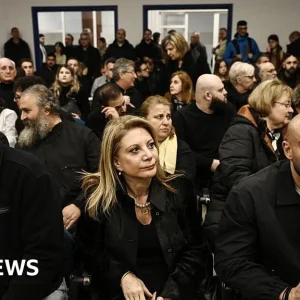
Grieving families desperate for justice crowded into a heavily guarded courtroom in central Greece on Wednesday as the trial over the nation's deadliest railway disaster resumed. The proceedings, which address the tragic loss of 57 lives in the February 2023 Tempi train crash, had already faced delays due to severe overcrowding and logistical chaos.
Inside the remodeled conference hall in Larisa, tensions ran high. Relatives of the victims struggled to secure seating, with many complaining that police officers were occupying the limited space. Maria Karystianou, whose 19-year-old daughter Marthi was killed in the wreckage, described the scene as an "absolute disgrace," noting that families were "packed like sardines." In response to the restricted access, defense attorney Zoe Konstantopoulou has formally requested that the proceedings be broadcast on video.
The catastrophe unfolded when a packed intercity passenger train traveling from Athens to Thessaloniki collided head-on with a freight train on the same track. A significant number of the victims were university students returning to their studies after a public holiday. The violence of the impact was so severe that some passengers burned to death after surviving the initial smash.
Among the young lives cut short was 20-year-old university student Anastasia Plakias, who died alongside her twin cousins, Thomi and Chrysa. Her grieving father, Dimitris, previously voiced the fury shared by many families, asking what other European nation would allow such an entirely preventable tragedy.
"We relatives call it a state assassination of our children, and all the people who were aboard that train," he stated.
A total of 36 individuals have been indicted, with 33 facing potential life sentences if found guilty. The defendants include the station master on duty—who failed to notice the two trains hurtling toward one another for a full ten minutes—along with other railway workers and two former Italian executives from the network's parent company, Ferrovie dello Stato.
Conspicuously absent from the docket, however, are any politicians. This exclusion has enraged campaigners who widely refer to the disaster as the "Tempi crime," viewing it as a fatal culmination of deep-rooted state corruption and systemic negligence.
Investigations later revealed that Greece's railway network had failed to utilize European Union funding earmarked for crucial safety upgrades. According to Laura Kovesi, head of the European Public Prosecutor's Office, modernizing the signaling system with those funds would have prevented the collision entirely. Furthermore, railway trade unions had repeatedly warned the government that a major catastrophe was imminent.
Suspicions of a government cover-up only intensified when authorities controversially bulldozed the crash site mere days after the incident, a move experts argue destroyed vital forensic evidence.
Despite immense public backlash and nationwide protests, Prime Minister Kyriakos Mitsotakis secured re-election shortly after the tragedy and has since survived two related no-confidence votes. While he has issued public apologies and pleaded for patience as the judicial process unfolds, the sheer scale of the trial—featuring 200 lawyers, 350 witnesses, and over 60,000 pages of evidence—ensures that the families' fight for accountability will likely drag on for years.