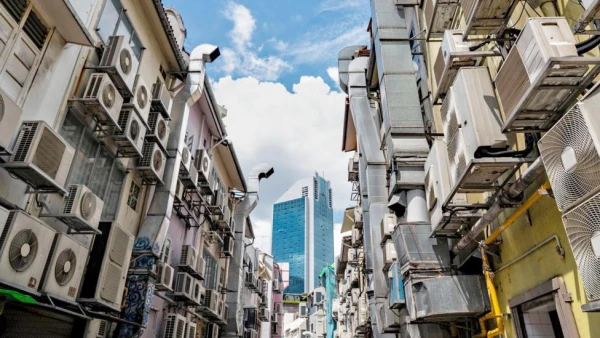
Singapore is confronting its deep-seated reliance on air-conditioning as soaring energy prices, triggered by conflict in the Middle East, compel the government to implement urgent conservation measures.
In a directive issued on April 8, Singapore's Ministry of Sustainability and the Environment announced that public offices must raise air-conditioning temperatures to at least 25°C (77°F). The ministry emphasized that each degree increase reduces energy consumption by approximately 10%. Government employees are also being encouraged to use fans and opt for public transportation to further conserve fuel.
"The government is taking the lead in our energy-saving effort as global fuel supply chains face disruption," the ministry stated.
This move places Singapore alongside other Southeast Asian nations scrambling to mitigate the economic impact of the regional energy crisis. Thailand has similarly advised setting air conditioners to 26-27°C and promoted remote work for public servants. The Philippines, which imports nearly all its oil from the Middle East, has shortened the government workweek, while South Korea has launched a public campaign advocating for shorter showers and restricted appliance use.
The crisis stems from Asia's heavy dependence on oil and gas shipments traversing the Strait of Hormuz, a critical maritime chokepoint that has seen significant disruption. According to the U.S. Energy Information Administration, about two-thirds of Singapore's crude oil imports originate from Middle Eastern countries.
Singapore's relationship with air-conditioning is deeply historical. The nation's founding leader, Lee Kuan Yew, once famously credited the technology with revolutionizing life in tropical climates by enabling productive indoor work. He noted that installing air conditioners in government buildings was among his first acts as prime minister, viewing it as essential to public sector efficiency.
Today, air-conditioning is ubiquitous. From government complexes and corporate towers to shopping malls, public transit, and most residences, cooled environments define daily life. It is common for office workers to keep sweaters at their desks to combat the chill, and pedestrians often experience blasts of cold air from shop entrances along city streets.
While Singapore has not yet tapped into national fuel reserves or imposed rationing, authorities have warned the public to brace for prolonged economic disruptions. Experts describe the situation as an "Asian crisis," with developing economies bearing the brunt due to high reliance on petrol vehicles and household gas.
Ichiro Kutani of Japan's Institute of Energy Economics remarked, "This is a tough lesson for Asia to learn from this crisis and aim to use oil efficiently and diversify our sources of supply."
The current energy squeeze is forcing a moment of reckoning for Singapore—a nation whose modern identity is intertwined with climate-controlled comfort—as it balances practical necessity against ingrained habit in an increasingly volatile global landscape.