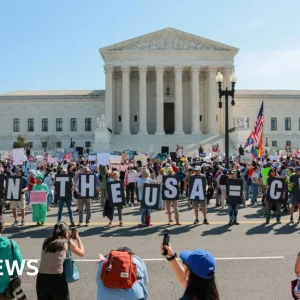
The US Supreme Court appears poised to deal a major blow to President Donald Trump’s immigration agenda, showing profound skepticism toward his executive order designed to end birthright citizenship.
During high-stakes oral arguments on Wednesday, a majority of the justices questioned the administration's legal authority to deny citizenship to children born in the United States to undocumented immigrants and short-term visitors. While the White House insists the controversial move is vital to curbing illegal border crossings, civil rights advocates argue it would illegally bulldoze over a century of established legal precedent.
Underscoring the gravity of the case, Trump made a rare in-person appearance at the high court. The presence of a sitting president highlighted his administration's determination to defend its immigration overhaul—and perhaps avoid a second consecutive judicial defeat, following the court's recent invalidation of his sweeping global tariffs.
For over two hours, US Solicitor General John Sauer attempted to persuade the bench that historical interpretations of the 14th Amendment were flawed. The amendment famously guarantees citizenship to anyone born or naturalized in the US and "subject to the jurisdiction thereof." Sauer argued that "jurisdiction means allegiance," claiming that undocumented parents remain legally bound to their home countries and therefore fall outside US jurisdiction.
The argument met stiff resistance. Chief Justice John Roberts—often a pivotal swing vote—openly doubted the administration's power to unilaterally strip citizenship rights from such a massive demographic.
"I'm not quite sure how you can get to that big group," Roberts noted.
Liberal Justice Elena Kagan also pushed back, reminding the administration that the 14th Amendment was explicitly drafted to embrace, rather than restrict, the long-standing English common law tradition of birthright citizenship.
The ghost of United States v Wong Kim Ark, an 1898 landmark ruling that cemented birthright citizenship for a child of Chinese immigrants, loomed heavily over the proceedings. Representing the plaintiffs, ACLU attorney Cecillia Wang leaned on the precedent to argue for the immediate overturning of Trump's order. The argument seemed to resonate with conservative Justice Brett Kavanaugh, who remarked that adhering to the 1898 decision could result in "just a short opinion."
Legal scholars suggest the justices may sidestep a messy constitutional battle entirely. Stephen Yale-Loehr, an immigration law expert, noted that the court prefers to rule on narrower statutory grounds whenever possible. In this scenario, the justices could strike down the executive order by pointing to a 1952 congressional law that already codified birthright citizenship.
A final decision is anticipated in June. If the court strikes down the order, it would serve as a massive hurdle to Trump's broader campaign promises regarding immigration enforcement and his aggressive expansion of executive power.
Unfazed by the chilly reception in the courtroom, Trump doubled down on his rhetoric following the hearing. In a social media post, he falsely claimed the United States is the "only Country in the World STUPID enough" to offer birthright citizenship. Later, at a White House Easter luncheon, he claimed the post-Civil War policy was strictly meant for the children of enslaved people, arguing it was never intended for "billionaire Chinese people who have 57 children that become American citizens."