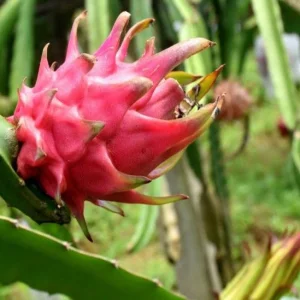
When Arun Srinivas traded his finance career for farming in 2020, he didn't turn to his family's traditional mango and coconut crops. Instead, he liquidated his stocks, sold his gold, and made a calculated gamble on an unconventional alternative: dragon fruit.
"It was a do-or-die decision," Srinivas recalls. Seeking a venture that offered both mental satisfaction and financial stability, he approached the agricultural shift like a Wall Street portfolio manager. After touring nearly a hundred farms and running risk-reward analyses, he determined that the climbing cactus was the ultimate cash crop. Today, his 11-acre farm in Karnataka yields a staggering 220 tonnes annually.
Srinivas is part of a growing wave of Indian agriculturists cashing in on the dragon fruit boom. Originally native to Central America and heavily commercialized by Vietnam, the vibrant, spiky fruit is fast becoming India's new agricultural gold standard.
The appeal is largely economic and environmental. Dragon fruit demands significantly less water than traditional crops, boasts a higher resistance to disease, and yields more stable market prices. Rather than a brief, intense harvest window like mangoes, dragon fruit provides a steady revenue stream by producing fruit continuously over a six-month period.
Dr. G Karunakaran, who heads the Centre of Excellence for Dragon Fruit at Bengaluru's Indian Institute of Horticultural Research, notes that the fruit was relatively unknown in India prior to 2009. Systematic research only commenced around 2014, but by 2021, the crop's popularity had skyrocketed.
"Dragon fruit adoption in India spread like mobile phones," Karunakaran explains. "Once farmers saw the income potential, everyone wanted to grow it."
Even so, the cultivation process is anything but ordinary. The plants are climbing cacti, typically supported by concrete pillars topped with circular rings. They also possess a fascinating botanical quirk: their flowers bloom strictly at night, often requiring manual pollination in the dark.
For farmers like Cheradeep Ma in the southern state of Kerala, midnight pollination is a life-threatening endeavor. "In Wayanad, going into the plantation at night is risky," he explains. "We have snakes, wild boars, sometimes even leopards and elephants." To mitigate these dangers, Ma relies on self-pollinating varieties. Diversifying away from traditional coffee and pepper, he now grows up to 100 different variants, buffering his income against volatile spice markets.
Meanwhile, researchers like Dr. Sunila Kumari are working to perfect the crop for local environments. Since 2019, Kumari has traveled the country gathering specimens to cultivate "elite mother plants" at her Haryana-based facility. Her goal is to identify and propagate variants that consistently produce the large, visually striking yields that buyers crave.
While global markets offer white and yellow-fleshed varieties, Indian consumers overwhelmingly demand large fruits with vibrant red flesh. As Kumari points out, these variants not only look better but offer a richer flavor profile, allowing them to command premium prices on the market.
With high market demand and government leaders championing its cultivation, dragon fruit is proving to be much more than a trendy exotic snack. For India's farmers, it is a resilient, highly lucrative lifeline.