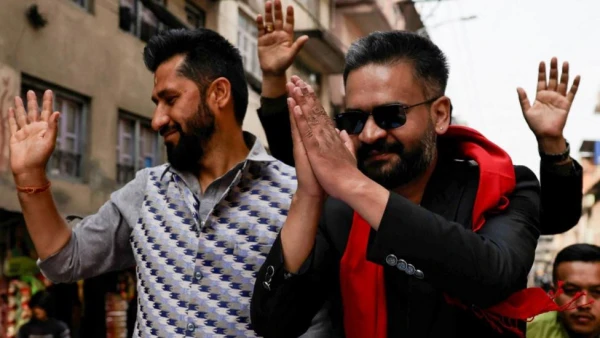
While young protesters in both Nepal and Bangladesh successfully toppled their governments in explosive demonstrations, their political fortunes have dramatically diverged. Nepal's youth movement has translated street power into parliamentary seats, while Bangladesh's activists watch from the sidelines as established parties reap the electoral rewards.
Last month, as Nepal inaugurated its new prime minister Balendra Shah alongside a parliament filled with young lawmakers, Bangladeshi activist Umama Fatema felt a pang of disappointment watching from afar. Fatema was among thousands of Gen Z protesters in Bangladesh who took to the streets in 2024, mirroring their Nepalese counterparts in bringing down their government.
Yet nearly two years later, Bangladesh's youth movement has gained no meaningful political power. In February's post-protest elections, the established Bangladesh Nationalist Party (BNP) won a historic majority while the new youth-led National Citizens' Party (NCP) performed dismally.
This stands in stark contrast to Nepal, where just a month later, the four-year-old Rastriya Swatantra Party (RSP) won by a landslide. The victory sent scores of Gen Z politicians to parliament and made former rapper Shah, who allied with the RSP, Nepal's leader.
"Personally, I felt disheartened," said Fatema. "When I saw how effectively the Nepalese youth were able to organise themselves, I could not help but feel disappointed about the situation in our own country. Bangladesh has not been able to deliver such a change."
Nepalese youth leaders attribute their success to their movement's ability to resonate with ordinary citizens. "The Gen Z protests tapped into a deep, long-standing frustration with the way things have been run," said KP Khanal, who was fielded by the RSP and won a seat in Kailali district. "Consistency was also key. We kept raising our voices around accountability and justice, over and over, and gradually that message reached far and wide."
Analysts point to Nepal's unique political landscape as another crucial factor. With an electoral system favoring coalition governments, no single party has ruled by majority in years. The country cycled through 14 governments in 17 years, creating public frustration with what critics called "political musical chairs."
"In Nepal's case, since all three established parties were discredited, the main beneficiary has been the youthful RSP and its leader," noted Nitasha Kaul, director of the Centre for the Study of Democracy at the University of Westminster.
The alliance between Balendra Shah and the RSP proved particularly effective. The RSP provided resources and wide reach for an electoral campaign, while Shah offered charismatic leadership without an established party structure. This partnership helped the RSP overcome controversies, including embezzlement accusations against party leader Rabi Lamichhane.
Youth activist Purushottam Suprabhat Yadav declined invitations to start a new party after the protests, recognizing the challenges of electoral politics. "Winning an election is not a joke," he explained. "Organising a movement and emerging victorious in an election are two different things. A political party cannot be formed out of nowhere."
Instead, Yadav joined the RSP in December, seeing it as a credible alternative with an established organizational network. The decision paid off when he was sworn into parliament last week as one of the RSP's lawmakers.
Kaul emphasized that winning elections requires more than protest energy. "A movement driven primarily by passion, frustration, or the politics of purity may be better at challenging the status quo—but not necessarily at winning elections," she said.
In Bangladesh, different dynamics played out. The authoritarian Awami League had dominated politics for years before being deposed by the Gen Z movement. This meant opposition parties were seen as "victims" who could channel anti-establishment sentiment.
"The BNP and Jamaat-e-Islami ended up reaping the benefits of anti-establishment sentiment in the elections," noted Kaul. These established parties positioned themselves as reform-minded and associated closely with the youth movement, absorbing protest energy that might have fueled newer organizations.
The NCP's decision to join a coalition led by the conservative Jamaat-e-Islami proved particularly damaging, alienating core youth supporters—especially women. The party won just six of the thirty seats it contested.
"By aligning with a regressive force in Bangladesh, the NCP became more about political power than about the Gen Z cause," said Rishi Gupta of the Asia Society Policy Institute in Delhi. "They squandered their golden chance to appeal to more voters."
Timing also played a role. Bangladesh's elections came a year and a half after the protests, potentially sapping momentum, while Nepal held elections just six months after its youth movement peaked.
The contrasting outcomes highlight the complex journey from protest to power, where organizational strategy, political alliances, and timing can determine whether youth movements translate street energy into lasting political influence.