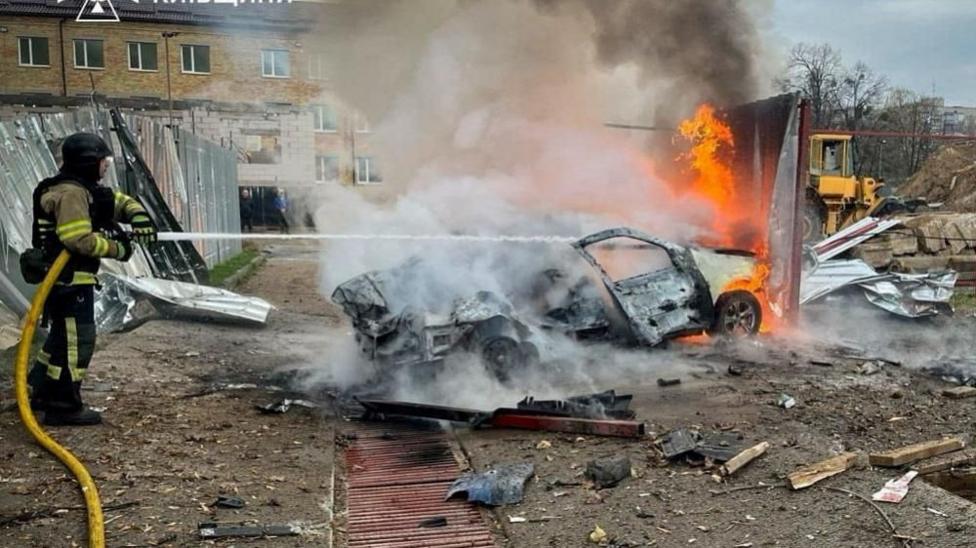
Ukrainian President Volodymyr Zelensky has condemned Russia for intensifying attacks during the Easter period, accusing Moscow of choosing "Easter escalation" over a proposed holiday ceasefire. The accusation follows a large-scale drone and missile assault that killed six civilians and injured 40 others across Ukraine.
Major daytime strikes, once uncommon, have become increasingly frequent as Russia launched hundreds of drones and missiles. In the Zhytomyr region, west of Kyiv, rescuers searched through rubble after entire rows of houses were destroyed. Kharkiv's mayor described the day's bombardment as "one of the biggest" the city has endured, with one woman killed and others critically injured.
Zelensky stated on social media platform X:
"The Russians have only intensified their strikes, turning what should have been silence in the skies into an Easter escalation."
He emphasized that his offer for a temporary truce during Orthodox Easter celebrations—observed next weekend in both Ukraine and Russia—remains open if Moscow agrees.
Meanwhile, Ukraine has conducted its own deep strikes targeting Russian energy facilities, including multiple drone attacks on the Ust-Luga port that forced Russia to suspend exports. An industrial plant in Togliatti, southern Russia, which produces rubber for military equipment, was also reportedly struck overnight, injuring one worker.
The conflict unfolds against a shifting global backdrop. U.S.-led peace efforts have stalled as President Donald Trump's administration focuses on the Middle East conflict. Zelensky revealed he communicated the ceasefire proposal to Trump's envoys, Steve Witkoff and Jared Kushner, inviting them to shuttle between Kyiv and Moscow to revive negotiations—though Moscow has postponed talks twice, describing them as "on hold."
Zelensky expressed concern that prolonged Middle East hostilities could divert U.S. defensive missiles, such as Patriot systems, away from Ukraine, potentially weakening its air defenses against Russian ballistic missiles. He noted:
"The longer the war in the Middle East continues, the greater the risk that we will receive less weaponry. This is extremely difficult—perhaps one of the most challenging tasks."
Despite these challenges, Zelensky acknowledged a British intelligence assessment indicating the frontline situation in eastern Ukraine is the "most favourable" for Kyiv in 10 months, with Russian advances slowing. He described the frontline as "stable," with minor territorial shifts but no imminent threat of a major Russian breakthrough, suggesting Ukraine's current focus is on holding positions rather than launching large offensives.