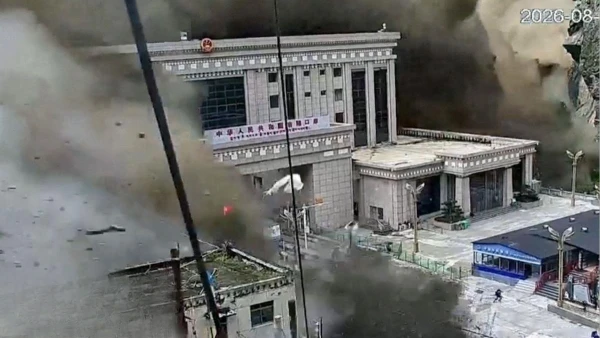
The destruction arrived as a dark, churning wall of debris. Triggered by a collapsed glacier high in the mountains, a massive torrent of mud, ice, and boulders barrelled into the Nepal-China border on the morning of August 26, obliterating everything in its path.
Captured on Chinese security cameras at 10:59 local time, the catastrophic surge took mere seconds to reshape the region's geography. Entire buildings, customs facilities, and the iconic Friendship Bridge connecting Rasuwagadhi in Nepal to Gyirong in Tibet simply vanished under the sludge. The neighboring trading village of Timure was similarly devastated.
The area serves as a vital and historically significant artery linking Kathmandu to Tibet. According to Kathmandu-based hydrologist Ajay Dixit, the steep gorges and high-velocity rivers make the region highly susceptible to severe geological events. On any given day, the crossing teems with international tourists, cargo drivers, local merchants, and spiritual pilgrims journeying to Mount Kailash.
A Bustling Morning Cut Short
Tragically, the crossing was exceptionally busy on the morning of the disaster. Nepalese immigration records provide a chilling timeline of the final moments before the flood hit. The digital system logged its last traveler at 8:35 AM Nepal time (10:52 AM in Tibet)—less than ten minutes before CCTV cameras captured the incoming wall of debris. By 8:37 AM, seismic monitors had registered the fatal glacial collapse above.
Just before the system went dark, 89 individuals had been cleared to exit Nepal, while four had entered. Among those departing were citizens of India, China, the US, Britain, Australia, Canada, and Italy.
Tika Ram Pokharel, a senior immigration assistant who survived only because he was in Kathmandu taking an exam, noted that electronic logs barely scratch the surface of the morning's true head count. He estimated that between 300 and 400 travelers were bottlenecked at the crossing, waiting for the Chinese side to process their paperwork.
The surrounding settlement of Ghatte Khola was far more than a simple checkpoint. It was a thriving hub containing dozens of homes, hotels, hydropower offices, and a bustling bus terminus. Pokharel fears the actual death toll could be staggering, estimating that up to 2,500 people may have been caught in the deluge—a figure that remains officially unverified.
Digital Echoes of the Missing
The human cost of the disaster is vast and still largely unquantified. Four Nepalese immigration employees were swept away, with only the department head's body recovered downstream so far. Furthermore, the Indian foreign ministry reports that at least 275 Indian nationals remain missing across Nepal following the recent regional floods.
Among those unaccounted for at the Chinese immigration facility is a group of 77 pilgrims and three staff members associated with the Isha Foundation, who were returning from Mount Kailash.
For many victims, the morning had been a mundane wait punctuated by casual updates sent to loved ones back home. Subhrasree Chakraborty, traveling as part of a 60-person tour group, was actively messaging her husband in India. At 7:57 AM, she sent a photo of her freshly stamped passport. Six minutes later, at 8:03 AM, she texted, "We are waiting to enter China."
That was her final message. When a specialized 21-member Chinese rescue team finally navigated through the wreckage to Gyirong days later, they were met with total devastation—a vibrant international gateway reduced to an unrecognizable landscape of ruin.