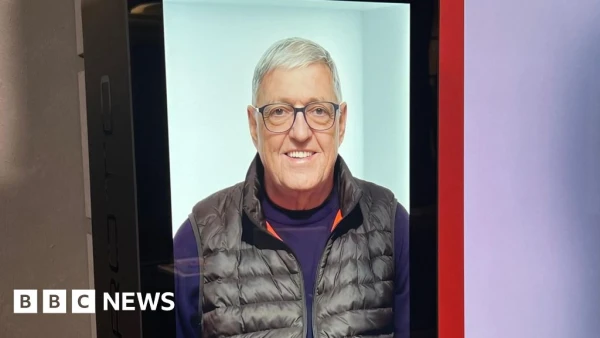
When Pam Cronrath's husband Bill died last year after nearly 60 years of marriage, she made a promise to give him a 'super wake.' What she didn't anticipate was that fulfilling that vow would lead her into the world of holograms—technology more often associated with pop stars than memorial services in rural America.
Pam, 78, lives in Wenatchee, Washington, an agricultural community at the edge of the Cascade Mountains. A self-proclaimed tech enthusiast, her career began in the early days of the internet. Years ago, at a medical conference, she saw a doctor appear as a full-body hologram broadcast live across the U.S. 'I was completely impressed. It stayed with me,' she recalls.
After Bill's death, the memory resurfaced. She wondered if the same technology could be used for remembrance. Finding help was difficult; many companies were too expensive or uninterested. Eventually, she connected with Proto Hologram and Hyperreal, which specialize in hologram and avatar technology. 'When you hear they're working with Michael Jackson's estate, and then it's me—Pam from Wenatchee—you wonder how it's going to work,' she says.
Pam had promised Bill she'd spend $2,000 on his 'super wake,' but the final cost was 'at least 10 to 15 times' that. 'But I still think Bill would be very much inspired by all of this,' she adds.
Unlike other 'digital afterlife' services that use pre-recorded answers, Hyperreal's approach involves comprehensive capture of likeness, voice, and motion. Since Bill had already passed, Pam wrote the script herself, drawing on six decades of shared life. 'I knew him for 60 years, so I wrote it the way I believed he would speak.' The most challenging part was the voice—Bill was quiet, with few recent recordings. Engineers worked to find a balance that family members would recognize.
At the memorial service, around 200 people gathered. When Bill's hologram appeared—life-size, from the waist up—on screen, the reaction was immediate. 'Now, before anyone gets confused, I'm not actually here in Valhalla today,' the hologram joked. 'Is this going to be fun?' The hologram delivered a speech and took part in a staged Q&A with Bill's nephew as host. Several attendees believed the exchange was live. One of Pam's sons noted only that 'his voice is just a little bit off.' For Pam, that reaction confirmed how close they'd come to perfection.
Seven months later, Pam still watches the recording. One moment stays with her: when the hologram says, 'I love you.' 'That means a lot to me,' she reflects. Hyperreal's founder, Remington Scott, says the project was entirely family-led. 'What we created was something they could return to—not once, but for generations.' He stresses the company doesn't see its work as grief tech: 'It's about digital human performance.'
Experts urge caution. Dr. Elaine Kasket, a cyberpsychologist, warns that such technology 'positions grief as a problem to be solved.' She questions the 'platformisation of grief' and its potential to commodify the dead. Dr. Jennifer Cearns of the University of Manchester emphasizes that 'these technologies should be used as forms of memorialisation rather than replacement.'
Pam understands the idea may unsettle some. For her, it was never about spectacle. 'It was about Bill,' she says. 'About honouring his humour, his kindness, and the way he made people feel.' As technology reshapes how we communicate, one thing is clear: for Pam, seeing Bill again—even as pixels and light—brought a measure of comfort no photo or video could.