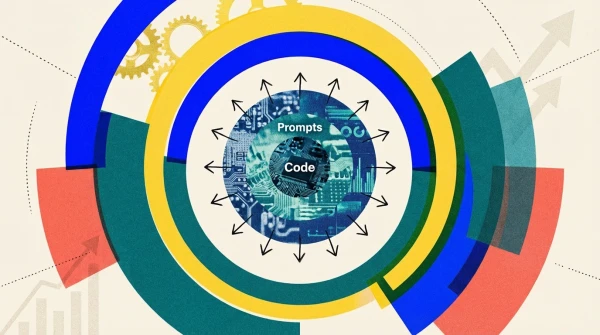
A new study from Chalmers University of Technology and Volvo Group challenges the narrative that AI agents are making software engineers obsolete. Instead, the researchers propose that agent-based systems expand the scope of software engineering through what they call "semi-executable artifacts"—such as prompts, workflows, policies, and decision routines—that shape system behavior as directly as code but rely on human interpretation.
The study introduces the "Semi-Executable Stack," a model with six concentric rings: core code (ring 1), prompts and natural language specs (ring 2), orchestrated agent workflows (ring 3), guardrails and monitoring (ring 4), organizational decision-making routines (ring 5), and societal and institutional fit (ring 6). Historically, software engineering focused on rings 1 and 2, but the paper argues that rings 2–5 are now critical engineering objects, with ring 6 increasingly determining practical success.
Key observations include that AI doesn't need to outperform the best engineer to change team dynamics; it just needs to be "good enough." Scale matters more than peak performance, as many small AI deployments can deliver more value than rare access to top experts. Additionally, as domain experts build systems using natural language, the demand for robust engineering practices grows.
The researchers reframe common criticisms—such as hallucinations, messy code, and prompt drift—as engineering challenges. Testing, monitoring, and maintenance become more important rather than less. They write, "The scarce skill shifts from building faster to deciding what is worth building or changing, which ring is actually being changed, how that change will be validated, governed, and maintained."
The paper accompanies a keynote at the Agentic Engineering 2026 Workshop in Rio de Janeiro and draws on industrial work with Volvo partners.