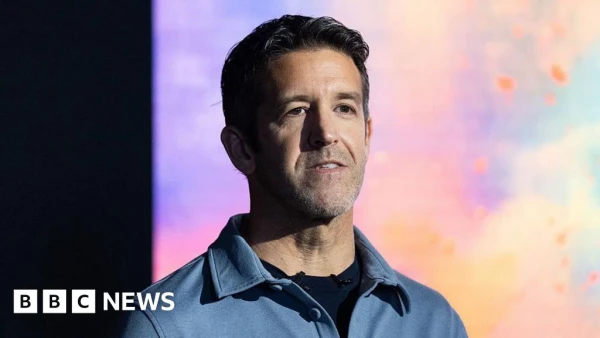
Apple has announced a significant leadership transition, with John Ternus set to become the company's new chief executive in September, replacing Tim Cook who will move into the role of executive chairman after 15 years at the helm.
Ternus, who currently leads Apple's hardware engineering division and has been with the company for 25 years, will officially assume the CEO position on September 1. Cook will remain as chief executive through the summer to facilitate a smooth transition before shifting to his new advisory role.
"This has been the greatest privilege of my life," Cook said of his tenure, during which Apple's market value soared from approximately $350 billion to over $4 trillion. In 2018, Apple became the first publicly traded company to reach a $1 trillion valuation under his leadership.
Cook praised his successor as a "visionary" leader with "the mind of an engineer, the soul of an innovator and the heart to lead with integrity and honour." He added, "He is without question the right person to lead Apple into the future."
Ternus has been instrumental in developing nearly every major Apple product over the past quarter century, including multiple generations of iPhones and iPads, the launch of AirPods and Apple Watch, and the transition of Mac computers to Apple's proprietary silicon processors.
"I am filled with optimism about what we can achieve in the years to come," Ternus said in a statement, referring to Cook as his mentor.
Industry analysts suggest the appointment signals Apple's strategic shift toward product innovation and differentiation. Dipanjan Chatterjee, principal analyst at Forrester, noted that while Cook delivered exceptional financial stability, Apple now faces the challenge of finding its "next growth engine" beyond the iPhone.
"The new leader must resist the temptation of incrementalism that has plagued Apple of late and escape the iPhone's gravitational pull," Chatterjee observed.
Gil Luria, managing director at DA Davidson & Co, suggested Ternus's hardware expertise could accelerate development of emerging technologies like foldable phones, wearable devices, and deeper integration of artificial intelligence into Apple's ecosystem.
Cook's departure from day-to-day leadership follows months of speculation about succession planning. The operational expert, who previously worked at IBM and Compaq before joining Apple, transformed the company into a global powerhouse through meticulous supply chain management and international expansion.
Timothy Hubbard, professor at the University of Notre Dame's Mendoza College of Business, noted that Cook's era perfected "refining, scaling and defending an extraordinarily powerful system."
"The real question now is whether that same organization can pivot toward exploration, where success depends on speed, uncertainty and a greater willingness to experiment," Hubbard said.
As Apple navigates increasing competition in artificial intelligence and evolving consumer technology markets, Ternus's appointment represents both continuity with Apple's engineering heritage and potential for renewed product innovation.