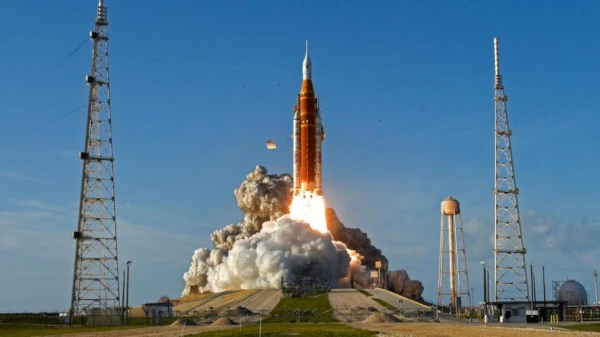
NASA's Artemis II mission has surpassed all critical benchmarks since its April 1 launch, demonstrating that humanity's return to the Moon is increasingly within reach. The mission's first week revealed that the Orion capsule functions flawlessly with astronauts aboard—a crucial validation that simulations could never fully replicate.
"Launching a rocket as important and as complex as SLS every three years is not a path to success," declared NASA Administrator Jared Isaacman, emphasizing the need for more frequent launches to sustain momentum.
The Space Launch System (SLS) rocket performed exceptionally, generating 8.8 million pounds of thrust and requiring fewer course corrections than anticipated. Dr. Simeon Barber, a space scientist at the Open University, noted, "Credit to them—they got it right the first time."
A key milestone was Orion's translunar injection burn, which mission lead Dr. Lori Glaze described as "flawless," setting the spacecraft on a precise trajectory toward the Moon.
The crew—Reid Wiseman, Victor Glover, Christina Koch, and Jeremy Hansen—successfully tested human interactions with the spacecraft, addressing minor issues like toilet malfunctions and water dispenser glitches. These real-world challenges provided invaluable data for future missions.
While the mission captured stunning images, including a solar eclipse from deep space and the Orientale basin on the Moon's far side, Professor Chris Lintott of Oxford remarked, "The artistic value of the images returned from Artemis and its crew is significant, but their scientific value is limited."
The most poignant moment occurred when the crew honored a lost loved one by naming a lunar crater "Carroll," highlighting the human element that makes space exploration resonate globally.
As Orion prepares for its final challenge—re-entry and splashdown in the Pacific Ocean—the mission has already reignited optimism for a lunar landing by 2028, proving that the path back to the Moon is not just possible but progressing faster than expected.