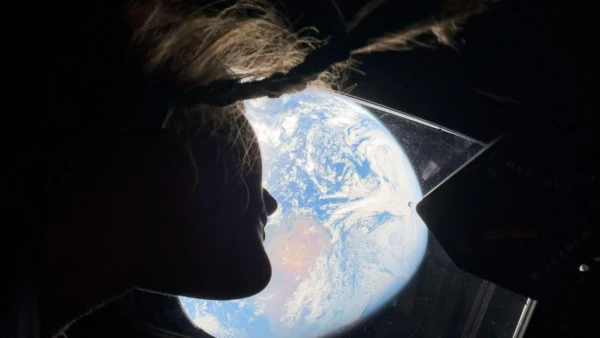
NASA's Artemis II mission is captivating global audiences with breathtaking images of the Moon and Earth, captured by astronauts during their historic journey. While these photos have garnered millions of social media likes, experts debate whether they offer genuine scientific value or are merely spectacular souvenirs from space.
Commander Reid Wiseman's 'Hello, World' photograph, taken when the spacecraft was roughly equidistant from both celestial bodies, showcases Earth with visible auroras and Venus glowing below. Another striking image reveals the Orientale basin on the Moon's far side—a massive crater that NASA claims is being seen in its entirety by human eyes for the first time, as Apollo missions never captured it fully due to orbital constraints.
NASA emphasizes the unique perspective of human observation, stating: 'Human eyes and brains are highly sensitive to subtle changes in colour, texture, and other surface characteristics.' The agency suggests this could lead to new discoveries about lunar features.
However, Professor Chris Lintott, an astrophysicist at the University of Oxford, offers a contrasting view: 'The value of the images coming back from Artemis and its crew is artistic, not scientific.' He notes that robotic explorers have extensively mapped the Moon's far side, with India's Chandrayaan-3 capturing detailed images in 2023 and China's Chang'e-6 collecting samples from the region in 2024.
Lintott explains: 'Unless something very unusual happens, there will be nothing for the astronauts to discover. For science they would need to do a systematic count, best done with a video camera, not looking out the window.' He adds, 'The images we already have back are beautiful, stunning and iconic—taken by astronauts not by robots. This is a voyage of exploration, not lunar science and that's fine!'
The mission occurs amid a renewed space race, particularly between the U.S. and China, both aiming to return humans to the Moon. A successful Artemis II could position the U.S. ahead, while NASA seeks to demonstrate its relevance amid funding challenges and competition from private companies like SpaceX.
Historically, space imagery has profound impact. The 1968 'Earthrise' photo, taken during the Apollo 8 mission, transformed global perspective by highlighting Earth's fragility during the Cold War. NASA likely hopes Artemis II will produce similarly resonant visuals.
As the crew continues their 10-day journey, live-streaming updates and sharing more images, the world watches—enjoying both the scientific narrative and the sheer wonder of human exploration.