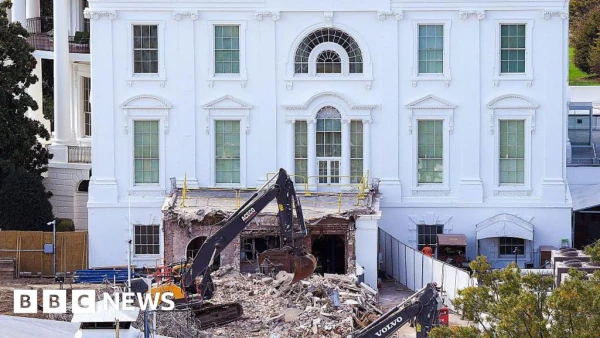
A federal appeals court has cleared the way for the complete resumption of construction on former President Donald Trump's White House ballroom, overturning a lower court's partial halt on the project.
The U.S. Court of Appeals for the District of Columbia issued an administrative stay on Thursday, allowing both underground and above-ground work to proceed pending a hearing scheduled for June 5. This decision follows the Trump administration's appeal against U.S. District Judge Richard Leon's ruling that had temporarily blocked above-ground construction earlier in the week.
Judge Leon had argued the project required congressional approval, suggesting the administration's classification of the ballroom as vital for national security appeared to be "an attempted work around." He stated, "National security is not a blank cheque to proceed with otherwise unlawful activity."
In response, Trump posted on Truth Social, accusing the judge of "attempting to prevent future Presidents and World Leaders from having a safe and secure large scale Meeting Place." He emphasized the underground complex would include bomb shelters and medical facilities, calling it "vital for National Security and Military Operations of the United States of America!"
The Justice Department supported the appeal, warning that halting construction "would imperil the president and national security and indefinitely leave a large hole beside the Executive Residence."
The legal battle stems from a lawsuit filed last year by the National Trust for Historic Preservation. The group alleges the White House violated law by beginning construction without submitting plans to the National Capital Planning Commission or seeking congressional authorization. Judge Leon initially halted the entire project in late March, finding proper procedures were not followed.
To make way for the new structure, the White House East Wing—built in 1902—was demolished in October. The planned ballroom is designed to accommodate approximately 1,350 guests. The White House has estimated the project's cost at $400 million, noting it is being funded entirely by private donors.
The appeals court's latest ruling represents a significant procedural victory for Trump's effort to redesign the historic property, though the legal dispute over its authorization continues.