A s someone with Cypriot roots and distant Greek heritage, I’m often asked the question: which is the best island? People lean in, expecting a secret – some tiny, untouched haven, known only to locals. My answer is always the same: Crete. With its fiercely proud identity, warm communities and exceptional food, it feels both deeply Greek and entirely itself.
For our anniversary weekend, my husband and I head to Lassithi, in the island’s far eastern corner. As a chef and food writer, I’m drawn to the area’s reputation for exceptional produce: Sitia extra virgin olive oil, creamy xigalo cheese, mountain honey and an abundance of excellent tavernas.
After an early start, we check into our hotel and freshen up. The Sand Suites is a new, adults-only retreat with just seven suites and a pathway leading directly to the wide, sandy Almyros beach and its clear shallow waters. Our suite is a serene hideaway with a private pool overlooking dramatic mountains.
Photograph: Guardian Graphics
For our first evening, we head to Karnagio in the pretty harbour town of Agios Nikolaos, a 10-minute drive up the coast (or a 45-minute walk). We’re told it offers the perfect introduction to the flavours of Lassithi. Despite a warning from Dimitri, the knowledgable manager at the Sand Suites, we order far too much food. We begin with Cretan classics: dakos (barley rusks softened with grated tomato, olive oil and mizithra cheese), alongside mizithropitakia (delicate mizithra-filled pies). More plates arrive. Spring onion-topped fava, tender horta (wild greens dressed generously with lemon), followed by melt-in-the-mouth sauteed lamb with locally made pasta and torched anthotyro cheese. Weeks later, and I am still thinking about that lamb.
Sand Suites, near Agios Nikolaos.
Eventually, we admit defeat. Unfazed by the unfinished dishes, the waiters arrive with a tray of complimentary sweets. Then comes a small carafe of raki. “Only if you join us,” I tell our waiter in my Cypriot-Greek. He needs little encouragement. “Yamas!” we declare, raising our glasses before downing the fiery spirit. The glasses are refilled. I know I’ll regret it in the morning, but we drink again, buoyed up by good food and excitement.
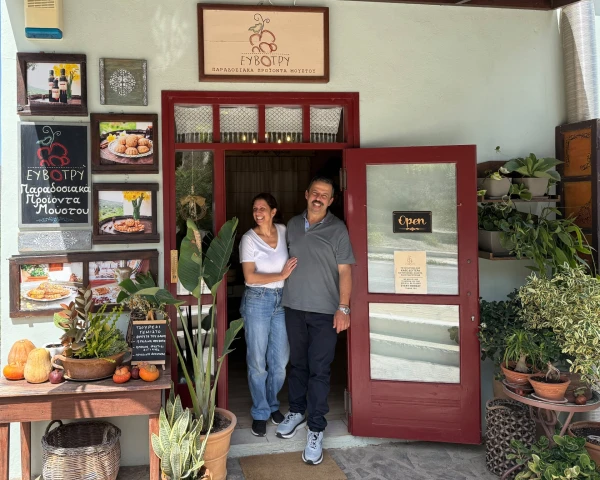
The next morning, fuelled by a delicious breakfast of fresh juice, coffee, pastries and freshly cooked eggs, delivered to our room, we jump in the car and drive half an hour south-east down the coast to Evotry, a roadside bakery that we are told to visit early to stand any chance of getting the best of the day’s bakes. Inside, it is a treasure trove: cakes and biscuits, alongside trahana (cracked wheat fermented with yoghurt), are all made by Stefanos and his wife Maria. Like many families in Greece, they press their homegrown grapes each September to make petimezi – a dark, naturally sweet grape molasses. As well as being sold in bottles, it also forms the base of many of their bakes, most notably kalitsounia (traditional Cretan sweet cheese pies). Found all around Lassithi, here they are distinct: Stefanos does not use refined sugar, relying solely on his petimezi for sweetness. We leave with a box and some cookies, and regret travelling with hand luggage only.
En route to our next stop of Mochlos, we are told about a 3,000-year-old olive tree so make a detour. The road climbs into the mountains, winding and steep. The tree is exactly as expected – vast and commanding, yet somehow gentle, like a great grandmother rooted in the landscape. We sit beneath its branches and eat the kalitsounia, surrounded by birdsong and the hum of bees.
We carry on east to Mochlos, a peaceful fishing village steeped in Minoan history on the far side of Mirabello Bay, and settle into Ta Kochilia, a waterfront taverna, for lunch. Octopus hangs drying in the sun; the sea sits just beyond the edge of the path. We keep things simple: grilled squid, horiatiki (Greek salad) and bread with local olive oil. The squid is tender, slightly charred, perfect. As always, there is fruit at the end, followed by something sweet –here, halva dusted with cinnamon –and strong Greek coffee, which briefly resets us before we continue inland.
skip past newsletter promotion after newsletter promotion
Dakos at Karnagio, in Agios Nikolaos. Photograph: Georgina Hayden
After a 10-minute drive into the hills above Mochlos, we arrive at Nektaria’s Kitchen, an open-air cookery school where every detail, from the rustic tables and benches built by Nektaria’s father Tassos, to the wood-fired oven and herb-filled demonstration kitchen, feels considered.
On Nektaria’s website a range of four-hour cookery classes are on offer, from vegetarian and meat menus to olive oil tours and local wine tastings. However, I get the impression that whatever it is you want to learn, Nektaria will be able to teach you.
Over coffee, we chat with Nektaria, her partner, her father, her best friend. We are offered homemade treats: more kalitsounia, this time perfumed with orange blossom, and mounds of biscuits – spiced melomakarona and almond honey patouda, both traditionally made for celebrations. A slow-cooked joint of pork is pulled out of the wood oven to entice us to stay and join them for a meal later on. And while the food is delicious, it is Nektaria herself who is the star of the show. Having left a career in finance just four years ago, it is clear what she has created is less a cookery school than a gathering point – a life reorganised around food, hospitality and community.
We begin our last full day in quaint Kritsa, one of Crete’s oldest villages, just a 15-minute drive inland from our hotel. A winding main street is dotted with a range of shops, traditional cafes and a fascinating natural history museum and tapestry centre.
We begin at the women’s cooperative, where biscuits and cakes are being prepared for nearby restaurants. A demonstration is also being set up in the outdoor kitchen and dining area. We stock up on boxes of syrupy sweet pastries and a bag of skioufichta, a type of rolled Cretan pasta, ready to recreate the lamb dish from Karnagio on our return home.
The writer with the eponymous chef of Nektaria’s Kitchen, in Kavousi. Photograph: Georgina Hayden
Our penultimate stop is an olive oil tasting at the family-owned Mourello, where visitors can book a range of olive oil experiences. Escaping the midday heat, we’re seated in a cool, quiet room overlooking valleys of olive groves. Over two hours, Eleni guides us through her family’s growing, harvesting and pressing process in such detail that I leave feeling I could semi-confidently turn my hand to making my own olive oil. We taste and compare different grades and types. Mourello’s Vedema oil is outstanding – peppery, punchy and silky. We leave with several bottles under our arms.
For our last evening we drive up into the hills again to the village of Kroustas. Sitting at 520m above sea level, the view over Mirabello Bay is dramatic. We’ve booked a table at Xatheri, a destination restaurant that feels deeply rooted in family life and is much loved in the area. Chef Konstantinos has built the menu around recipes from his parents and grandmother, who we are told has just stopped by to check in on service. We start with one of her recipes, dolmadakia, small, delicate stuffed vine leaves. Goat stew arrives rich and slow-cooked, tossed through spaghettoni and topped with aged graviera cheese. And finally gamopilafo, also known as “wedding rice”, which feels appropriate given it’s our anniversary. It is deeply comforting and impossibly rich.
Despite protesting, dessert appears – a generous slice of galaktoboureko, a just-set vanilla cream encased in crisp syrupy filo, which is somehow light enough to avoid being cloying. There is dessert wine, then raki, of course. We leave not just full, but slightly reoriented – already thinking about returning to this calm corner of Crete.
The trip was provided by Simpson Travel , which offers a week at the Sand Suites from £1,124 pp B&B, including flights and car hire