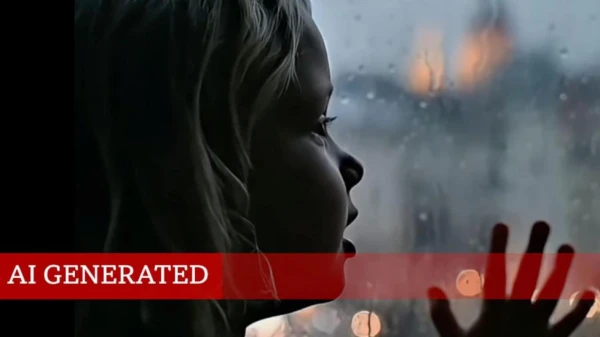
As Hungary approaches a pivotal election this Sunday, artificial intelligence-generated videos depicting fabricated war scenes have become a central weapon in Prime Minister Viktor Orbán's campaign to secure a fourth consecutive term.
In February, the ruling Fidesz party posted a disturbing AI-generated video on its social media channels. The clip shows a young girl waiting at a window for her father to return from war, before cutting to a scene of the same man—blindfolded and bound—being executed by captors. The video explicitly targets Orbán's main challenger, Péter Magyar of the centre-right Tisza party, with on-screen text claiming: "Péter Magyar doesn't want you to see this video. He doesn't want you to see what an irreversible tragedy it is to join a war."
"The video is an AI video, but the war is really horrible," the Fidesz-produced content states, while making unsubstantiated claims that Magyar would bring Russia's war against Ukraine to Hungary's doorstep.
Magyar has vehemently denied these allegations, with his party's manifesto explicitly pledging not to send troops to Ukraine or revive conscription. He condemned the AI execution video as "heartless manipulation," stating that Fidesz had "crossed all limits."
Zsófia Fülöp, a journalist at Hungary's independent fact-checking site Lakmusz, notes that while anti-Ukrainian narratives from the ruling party aren't new, the scale of generative AI use in this campaign represents a dangerous escalation.
"It is omnipresent in this campaign, especially in the communication of the ruling party and its media and proxies," Fülöp said. "They've used it before but now it's massive."
Another viral AI creation emerged last month from the National Resistance Movement (NEM), a pro-Fidesz activist group. Their video—viewed over 3.7 million times—depicts a fabricated phone conversation between European Commission President Ursula von der Leyen and Péter Magyar discussing sending money to Ukraine. The video was shared widely by pro-government media and politicians, including Orbán himself, who acknowledged it was AI-generated but warned it could become reality.
The disinformation campaign extends beyond videos. When Hungarian anti-terrorism police recently arrested seven Ukrainian bank workers transiting with cash and gold, pro-government outlets used hyper-realistic AI-generated images to report on the arrests—images that Facebook's fact-checking service later labeled "partly false" due to numerous inaccuracies when compared to official documentation.
Éva Bognár, a researcher at Central European University's Democracy Institute, describes the political atmosphere as being "in a state of hallucination."
"In a way the whole campaign is a disinformation campaign because it's all based on a complete false narrative that we're on the brink of war," Bognár said.
Despite the barrage of AI-generated content, the strategy appears to have had limited impact on voters, with most opinion polls showing Magyar's Tisza party leading the race. The election outcome will determine whether Orbán extends his 16-year rule or faces an unexpected political transition in a nation where relations with Ukraine have deteriorated sharply despite previous support for EU membership bids.
Research from Policy Solutions indicates the effectiveness of such campaigns, showing that 64% of Hungarians now hold negative opinions of Ukrainian President Volodymyr Zelensky—a sentiment level barely lower than the 67% who dislike Russian President Vladimir Putin.