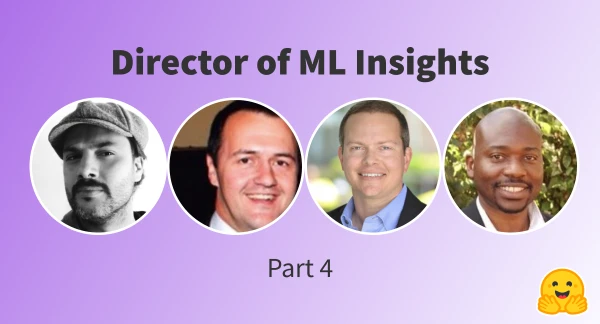
Welcome back to the Director of Machine Learning Insights Series. In this fourth edition, we hear from four ML directors—Javier Mansilla, Shaun Gittens, Samuel Franklin, and Evan Castle—on how machine learning is transforming their industries.
Javier Mansilla on E-commerce
Background: Javier is a seasoned entrepreneur and former CTO of Machinalis, acquired by Mercado Libre. He now leads the ML platform, user tracking, AB testing, and open-source office at the Latin American tech giant.
1. How has ML made a positive impact on e-commerce?
ML has made the impossible possible in areas like fraud prevention and optimized processes. It enabled next-level UX at lower cost, such as discovery and serendipity in user journeys. We apply ML to search, recommendations, ads, credit-scoring, moderation, forecasting, logistics, and even infrastructure optimization.
2. What are the biggest ML challenges within e-commerce?
Beyond technical challenges like real-time personalization, the biggest challenge is maintaining focus on the end-user. E-commerce is scaling rapidly, and balancing performance with user-centricity is key.
3. A common mistake you see people make trying to integrate ML into e-commerce?
Jumping to advanced models without having solid data foundations or clear business objectives. Start simple, validate the data pipeline, and ensure the problem is well-defined.
4. What excites you most about the future of ML?
The potential for more seamless, personalized experiences that anticipate user needs, and the ability to make complex decisions in real time.
Shaun Gittens on Engineering
Background: Shaun is a Director of ML focusing on engineering applications, bringing extensive experience in building intelligent systems.
1. How has ML made a positive impact on Engineering?
ML has improved efficiency in code review, bug detection, and automated testing. It helps engineers focus on creative work by handling repetitive tasks.
2. What are the biggest ML challenges within Engineering?
Data quality and scarcity are major hurdles. Engineering data is often messy or sparse, and labeling can be expensive.
3. What’s a common mistake you see people make trying to integrate ML into Engineering?
Treating ML as a silver bullet. Without a clear metric for success and iterative validation, projects often fail to deliver value.
4. What excites you most about the future of ML?
AI-assisted development tools that augment human creativity and enable faster, more reliable software delivery.
Samuel Franklin on Education
Background: Samuel is an ML director in the education sector, working on personalized learning and assessment tools.
1. How has ML made a positive impact on Education?
ML enables adaptive learning platforms that tailor content to individual student needs, improving engagement and outcomes.
2. What are the biggest ML challenges within Education?
Privacy concerns and the need for interpretable models. Decisions about students' educational paths require transparency and fairness.
3. What’s a common mistake you see people make trying to integrate ML into existing products?
Adding ML as a feature without rethinking the user experience. It should seamlessly integrate into the workflow, not be a separate tool.
4. What excites you most about the future of ML?
The potential for lifelong learning companions that adapt to each learner's pace and style.
Evan Castle on SaaS
Background: Evan leads ML initiatives in the SaaS space, focusing on customer intelligence and product optimization.
1. How has ML made a positive impact on SaaS?
ML improves churn prediction, customer segmentation, and personalized recommendations, directly boosting retention and revenue.
2. What are the biggest ML challenges within SaaS?
Handling data silos and maintaining model performance as products evolve. Continuous deployment and monitoring are critical.
3. What’s a common mistake you see people make trying to integrate ML into SaaS?
Over-engineering the solution. Start with a simple model that adds immediate value, then iterate based on feedback.
4. What excites you most about the future of ML?
Autonomous systems that can detect and respond to customer needs in real time, creating truly intelligent SaaS products.
Interested in building ML solutions faster? Visit hf.co/support.