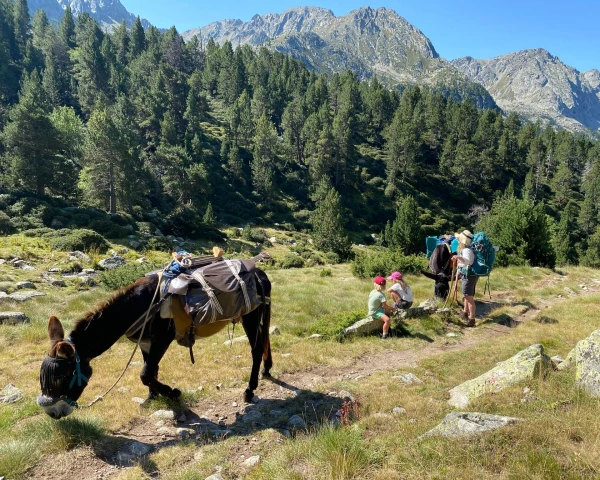
Our donkeys were on loan from Burrotrek, a small outfit run by Swiss-born Denise Wirth. Twenty years ago, Denise spent four and a half months walking the Camino from Switzerland to Santiago de Compostela with two donkeys. She liked Spain, and she loved donkeys, so she settled on the idea of offering donkey treks in the Pyrenees. She has not looked back. For much of the year she is based near Cadaqués, offering self-guided itineraries through vineyards and along the Mediterranean coast. But for the summer months, when temperatures soar, she relocates with her donkeys to Cal Jan de la Llosa in the province of Girona, a gorgeous ruin of a farm several miles up an unpaved track.
My family (myself, Ulli, and our two kids, aged five and seven) bought Interrail passes and caught the sleeper train from Paris, crossed the border to Catalonia at Puigcerdà, and after a late lunch of tapas at the station bar, took a taxi for an hour up winding roads to the farm. That first night we pitched our tents in a field behind the barn. The dark welled up from the valley floor, and house martins shuttled through the dusk. We fell asleep to the rushing river and the occasional braying of a donkey.
The next morning we met our animals. We would borrow two donkeys, Om and Rebot. Om was described as "sporty," while Rebot was older and content to bring up the rear. Denise ran us through the basics: how to saddle them, groom them, and check their hooves. A donkey can carry a fifth of its bodyweight, which meant about 30kg each. We had a lot of gear: a week's food and camping equipment.
The going was easy at first, along wooded valleys and through pretty stone villages. At lunchtime, we tied the donkeys to graze beside a stream while we splashed around, then lay basking on rocks eating bread and cheese. On the second night, we camped in a meadow during the worst storm I've ever known. It came out of a clear blue sky—suddenly hailing, the ground white. The donkeys stood stolidly under a tree. The downpour continued till dawn, thunder like cannon fire. The kids slept through it, but Ulli and I sat up all night. By morning, the kids were the only dry things we had. The sun was out and the grass was steaming. We saddled the donkeys and carried on.
We dried out at Refugi dels Estanys de la Pera, a wonderful cabin with warm hospitality and good food. Then the path began to climb toward Andorra. At times it felt like we were carrying the donkeys up the mountain. A group of Spanish hikers advised us to shout "arré," an Arabic word imported by the Moors. The donkeys took cautious, dainty steps, selecting each foothold. We learned they set the pace, and we should follow where they led.
By the time we made the border at Perafita Pass, at 2,574 meters, we were in the clouds and giddy with success. As we descended, the cloud burned off, revealing Andorra: a vast plateau of long grasses, crooked spruce trees, and lakes in ancient glacial craters. It was achingly beautiful and wild. A herd of chamois flushed from hiding and took off down slopes at full pelt.
The path unwound along rivers—Riu de Perafita, Riu Madriu—rattling over rocky beds. We drank from springs and plunged into icy pools. One morning, a herd of horses approached to examine their diminutive relatives; Om and Rebot stood stoic until the horses galloped on.
I had worried this trip might be a hard sell for the kids, but they found endless fun. Every time we stopped, they found a stream, a frog, or a marmot to chase. The days weren't long—six or seven miles at most. The donkeys and mountains meant they scarcely noticed we had tricked them into walking. In the evenings, they groomed the animals and charged about camp. They ate everything we gave them and fell asleep in seconds.
We spent our last night at Refugi de l'Illa, a vast, metal-clad, solar-panelled structure that seemed to have touched down from space. We washed in hot water, drank wine, and slept on a mattress. It was nice, but I hadn't missed it. As we walked back into Spain, the donkeys seemed to know they were nearing home. The path eased down through pastures of wild flowers, and by dinner time on the eighth day we were back at the farm.
Some of my happiest moments as a parent are when sharing the basic pleasures—cooking after a long day outside, or looking up at a starry sky. We pitched our tent for one final night and reluctantly handed our donkeys back. They trotted into their field with the others, nosing each other's necks in welcome. We were very sorry to see them go.
The trip was provided by Burrotrek; donkey hire from €55 a day including an introductory course and equipment. Half-board at Refugi de l'Illa, €61 adults/€48 children. Half-board at Refugi dels Estanys de la Pera, €...