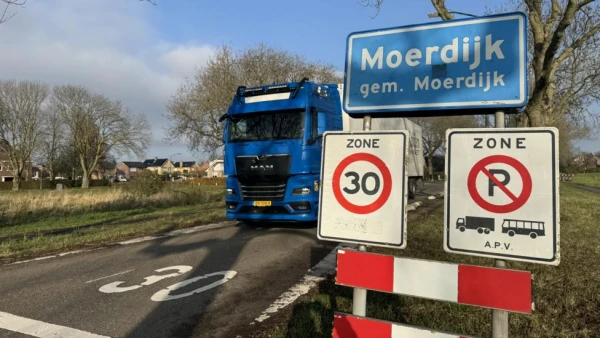
In the southern Netherlands, the small fishing village of Moerdijk—home to approximately 1,100 residents—stands on the brink of being erased from the map. The Dutch government has identified the community as a prime location for a massive new high-voltage substation, a critical component in connecting the nation's expanding offshore wind farms to the national power grid.
Moerdijk's strategic position along the Hollands Diep estuary, near major ports, highways, and existing power lines, makes it an attractive site for planners. However, this very advantage now threatens the village's existence, with homes potentially facing demolition within the next decade.
"We are being brought to the slaughter house," says Jaco Koman, a third-generation fishmonger whose family has worked the local waters since 1918.
Koman's business, which supplies live eels to high-end restaurants across the country, thrives on the deep waters and open land that also appeal to energy planners. The uncertainty weighs heavily on residents.
"You go to bed with it and you wake up with it," Koman reflects on the looming threat. "Are they really saying that you have to go with your village?"
The village now exists in a state of anxious limbo. "For sale" signs dot properties, but few buyers are willing to invest in a community with such an uncertain future. Flags hang at half-mast in what locals describe as a gesture of mourning for their village.
At the local grocery store, owner Andrea shares her personal connection to Moerdijk. Her husband built their home by hand, and all three of their children were born there.
"I'm scared I'll lose my house," she admits. "There's so much life here. But in 10 year's time it may be nothing."
Adding to her distress is the village cemetery, where her grandparents and in-laws are buried. She wonders what would happen to the graves if the area is redeveloped.
The conflict in Moerdijk reflects broader national tensions. The Netherlands, with its dense population and limited land, struggles to balance housing, agriculture, nature conservation, and now the infrastructure required for large-scale renewable energy projects.
Geerten Boogaard, a professor of local government at Leiden University, explains the power dynamics at play.
"In the end we are a centralist state," Boogaard notes. "When the national government says, 'This is vital national interest,' there are instruments to effectively implement that."
While local councils can object and residents can challenge decisions, the central government ultimately holds legal authority to proceed—though doing so carries significant political and financial costs.
Jacques, a 71-year-old retired engineer living in an eco-friendly home on the village outskirts, has watched the landscape transform since he moved there in the 1990s.
"This village will be demolished. That I know for sure," he states, noting the proliferation of wind turbines, distribution warehouses, and power pylons that now dominate the horizon.
The Dutch government has postponed its final decision on Moerdijk's fate, with an announcement expected later this year. The proposed development would require approximately 450 hectares (1,100 acres) of land—equivalent to about 700 football pitches—to accommodate not only the power facility but also several hydrogen production factories and pipelines for transporting ammonia and hydrogen.
Mayor Aart Jan Moerkerke of Moerdijk municipality acknowledges the immense pressure, noting that the council has reluctantly accepted that the village may need to be sacrificed to avoid wider regional disruption. The standoff in Moerdijk represents more than a planning dispute—it's a collision between a tight-knit community's way of life and a nation's urgent transition to renewable energy.