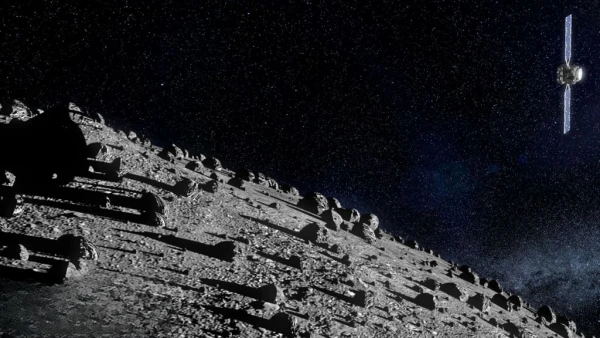
In a historic test of planetary defense, the European Space Agency’s Hera spacecraft is set to unveil the first detailed images of an asteroid deliberately struck by NASA’s DART mission four years ago—a cosmic experiment that could one day save Earth from a catastrophic collision.
The target, a 150-meter-wide asteroid named Dimorphos, orbits a larger space rock called Didymos. In September 2022, NASA’s DART spacecraft hurtled into Dimorphos at 22,000 km/h, altering its orbit by a staggering 33 minutes. The impact, which obliterated the DART probe, sent a 10,000-kilometer trail of debris streaking through space, visible even from Earth-based telescopes.
Now, Hera’s arrival marks the next phase of this groundbreaking mission. Equipped with advanced instruments and two miniature satellites, the spacecraft will spend a year meticulously studying the aftermath of the collision. Scientists hope to uncover critical details about the asteroid’s structure—whether the impact left a gaping crater or reshaped the entire rock.
"Hera is like a detective returning to the scene of a crime to piece together what really happened," said Patrick Michel, principal investigator of ESA’s Hera mission. "We need to know the asteroid’s final state—its mass, composition, and how much it was altered by the impact."
The findings could be pivotal. If humanity ever detects an asteroid on a collision course with Earth, understanding how to deflect it effectively could mean the difference between survival and disaster. "This mission helps us refine our models," explained Prof. Simon Green, a planetary scientist on Hera’s team. "We’ll learn how much force is needed to nudge an asteroid off course—and how early we’d need to act."
Asteroids remain a silent but real threat. While the largest—over a kilometer wide—could trigger global devastation, mid-sized rocks like Dimorphos could flatten a city. Though no known asteroids pose an immediate danger, scientists estimate thousands of undetected space rocks lurk in our solar system, some large enough to cause regional destruction.
"We’ve mapped the biggest threats, and none are heading our way," said Carolyn Ernst of Johns Hopkins Applied Physics Laboratory, who worked on both DART and Hera. "But there’s a dangerous middle ground—asteroids we haven’t spotted yet. If one were on a collision course, we’d want every tool at our disposal to stop it."
Hera’s mission is just the beginning. In 2027, NASA’s NEO Surveyor telescope will launch to hunt for more hazardous asteroids, while future missions like ESA’s Ramses and NASA’s Osiris-Apex will study Apophis, a 450-meter-wide asteroid that will pass within 32,000 kilometers of Earth in 2029—closer than some satellites.
For now, the world waits as Hera prepares to reveal the scars left by DART’s dramatic collision. The images, expected later today, could rewrite the future of planetary defense—and humanity’s place in the cosmos.