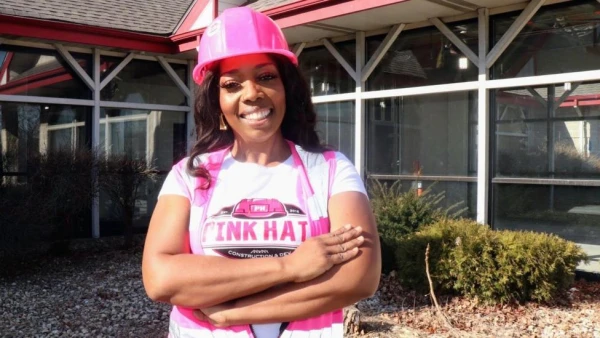
Traci Quinn's journey from incarceration to industry leadership embodies the resilience of second chances. After serving three years in federal prison, this Chicago grandmother has transformed her life by founding Pink Hats—a construction firm that's breaking barriers while rebuilding communities.
Quinn's path to construction was anything but conventional. A former nurse who witnessed cannabis's medical benefits firsthand, she faced trafficking charges in 2016 for transporting legally purchased medical cannabis from California to Tennessee. "I bawled, I cried, and asked God why," she recalls of her sentencing. "I'd taken care of people my whole life. God told me he didn't have me there as punishment, but on purpose."
While incarcerated, Quinn envisioned creating a construction company focused on revitalizing Chicago's most underserved neighborhoods. Despite having zero industry experience, she launched Pink Hats in 2020 shortly after her release, navigating both a global pandemic and systemic barriers.
"It's a male-dominated world and they don't always respect you," Quinn explains about the construction industry, where women comprise just 11% of workers and Black women less than 7%. "You absolutely have to work harder as a black woman. There will always be people who think you're less qualified when you step in the room."
Early challenges included unreliable subcontractors and financial hurdles. "I had garages leaning to one side, everything looked torn up and ugly because I was using people with no experience," she admits. When applying for city contracts required upfront capital she lacked, Quinn sought help from nonprofit organizations to master business finances and bidding processes.
Her persistence paid off spectacularly. Pink Hats generated $125,000 in its first year, growing to over $1 million in revenue by 2025. The company now employs Quinn's four daughters as core team members alongside six part-time female staff, specializing in residential and commercial transformations that serve marginalized populations.
Recent projects include renovating a 30-room recovery home for women overcoming substance abuse and constructing 10 affordable single-family homes for a Christian organization. The firm's innovative approach extends to sustainable materials like hemp-based insulation—an ironic full-circle moment for Quinn given her cannabis-related conviction.
"It's been pretty cool learning about hemp," she notes. "I love using it because it's non-toxic, pest-resistant, fire-resistant and mould-resistant."
Quinn's vision continues expanding. A recent $250,000 city grant will transform office space into trade classrooms offering painting, plumbing, and construction training—with particular focus on helping formerly incarcerated individuals reintegrate into society.
"My ultimate goal is to create transitional homes for women coming out of prison," Quinn reveals. "They would be able to stay in it for a year, get some work under their belt, learn about financial literacy, and then have the chance to purchase it."
Industry leaders recognize Quinn's impact. Irma Holloway of Black Contractors Owners & Executives observes: "Traci has carved out a distinctive niche by leading with professionalism, precision and purpose. Her work proves that when women stay the course and remain committed to their craft, they not only reach the finish line—they redefine it for others."
Reflecting on her unconventional journey, Quinn shares: "I used to be prideful and probably would've looked down on somebody coming out of prison. I told my daughters things had to happen this way—for their growth and for mine. It's been an amazing journey."
From prison sentence to construction success, Traci Quinn's story demonstrates how adversity can forge unexpected paths to community transformation and personal redemption.