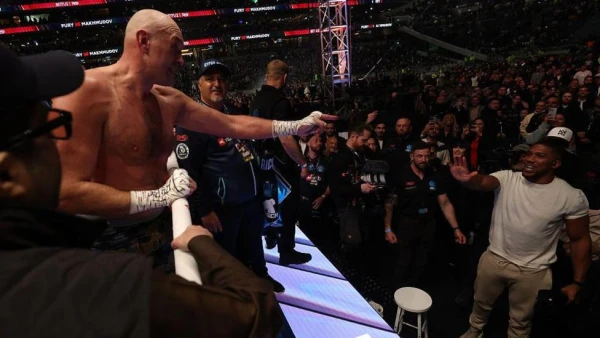
After a decade of anticipation, the heavyweight showdown between Tyson Fury and Anthony Joshua continues to evade reality, with recent events highlighting the persistent disconnect between the two British champions.
Following Fury's commanding victory over Arslanbek Makhmudov at Tottenham Hotspur Stadium, a fleeting moment suggested the rivals might finally align. Fury leaned over the ropes, gesturing for Joshua to join him in the ring—a gesture that reignited the long-standing rivalry. Yet Joshua remained firmly in his seat, refusing to engage in the theatrics, underscoring the subtle power struggle that has defined their relationship for years.
"He didn't want the smoke," Fury remarked backstage. "Ten years in the making and still there's uncertainty if it's going to happen next."
The aftermath saw conflicting narratives emerge. Saudi Arabia's General Entertainment Authority chairman, Turki Alalshikh, spoke as if an announcement was imminent, while Netflix prematurely posted about an autumn UK fight—a claim swiftly denied by Fury's promoter, Frank Warren. Team Fury now asserts they have signed a contract, placing the onus on Joshua, ensuring the blame game persists.
A Fight Past Its Prime?
Many believe the ideal window for this clash has already closed, with 2019 or 2021 often cited as missed opportunities. Both fighters are arguably beyond their peak, yet the public's fascination endures, partly due to a lack of compelling alternatives in the heavyweight division. Young prospects like Moses Itauma or headline-grabbing welterweight Conor Benn still pale in comparison to the drawing power of Fury and Joshua, whose bout would likely outdraw most global events regardless of venue.
"If it isn't AJ next, I'm not interested in boxing again. It's either him or I'm gone," Fury declared, emphasizing his singular focus.
Should Joshua Seek an Interim Fight?
There's a compelling argument for Joshua to take a lower-stakes bout first. While Fury used the Makhmudov fight as a comeback warm-up, Joshua has faced only Jake Paul in the past 18 months, raising concerns about ring rust against elite competition. Additionally, Joshua has endured personal trauma, including a December car accident that claimed the lives of two close friends.
"I was in a serious incident maybe four months ago," Joshua noted, as pressure mounted for him to accept Fury's terms.
Fury expressed sympathy for Joshua's circumstances, acknowledging each fighter's personal battles, but warned against delay, citing the cautionary tale of Mayweather vs. Pacquiao—a fight that ultimately disappointed after years of buildup.
The Netflix Effect and Future Prospects
Fury's return coincides with the release of season two of At Home with the Furys on Netflix, leveraging the platform's 325 million subscribers to reintroduce boxing to a mainstream audience. His comeback fight may rank among the UK's most-watched in years, hinting at the colossal interest a Fury-Joshua matchup would generate.
Potential venues like Dublin's Croke Park, with its 80,000-plus capacity, are already in discussion. Yet the location feels secondary; the central question remains whether this generation will witness these two icons share the ring before time runs out. The perfect moment may have slipped away, but the allure of this elusive fight refuses to fade.