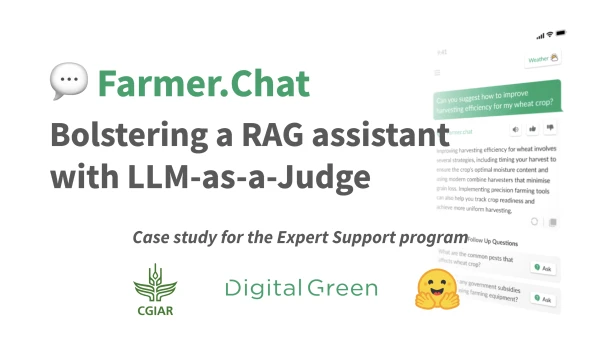
In a recent case study, expert support engineers demonstrated how integrating an LLM-as-a-Judge mechanism can significantly improve the reliability and accuracy of retrieval-augmented generation (RAG) applications. RAG systems, which combine information retrieval with language generation, often face challenges such as hallucination or irrelevant responses.
By employing a secondary LLM to evaluate the quality of the initial output, the team was able to flag and filter low-confidence answers, reducing errors and increasing user trust. This approach allowed for dynamic feedback loops where the judge model could assess factual consistency, relevance, and completeness without requiring extensive manual oversight.
The case study highlights practical implementation steps, including prompt engineering for the judge model, threshold setting for acceptance, and handling edge cases. The results showed a measurable improvement in answer accuracy and user satisfaction, offering a scalable solution for production RAG deployments.
Experts note that while LLM-as-a-Judge adds latency and computational cost, the trade-off is often worthwhile for applications where accuracy is critical. This technique is gaining traction as a best practice in enterprise AI deployments.