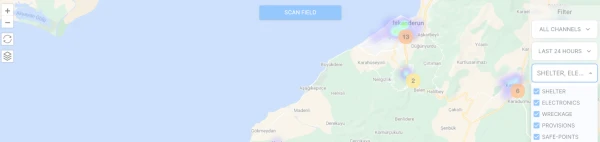
On February 6, 2023, devastating earthquakes of magnitudes 7.7 and 7.6 struck South Eastern Turkey, affecting 10 cities and resulting in over 42,000 deaths and 120,000 injuries. Within hours, a group of programmers launched a Discord server to develop afetharita (disaster map), an application to help search & rescue teams and volunteers locate survivors. The app evolved from a need to extract information from social media posts where survivors shared their locations and needs.
A team of volunteers collaborated on Hugging Face to train machine learning models. They built an OCR application using easyocr and Gradio to extract text from images, then used a fine-tuned NER model (based on bert-base-turkish-cased) to parse names, phone numbers, and addresses. The extracted addresses were sent to a geocoding API to obtain coordinates for the front-end map.
For intent classification (identifying needs like shelter, food, or logistics), the team initially experimented with zero-shot NLI models and few-shot prompting of closed-source LLMs. They eventually fine-tuned a BERT text classification head, which took about three minutes on a single GPU. They benchmarked models on a leaderboard and focused on reducing false negatives.
To evaluate the NER model, they set up a labeling interface using Argilla and Gradio, allowing crowd-sourced validation. The dataset was deduplicated and used for further improvements.
The project relied on Hugging Face's Inference API for model serving, ensuring uptime and handling traffic spikes. The collaborative effort demonstrated how rapid ML development can aid disaster response.