-
[Your account](https://account.bbc.com/account?lang=en-GB&ptrt=https%3A%2F%2Fwww.bbc.co.uk%2Fnews%2Farticles%2Fcvg7vpyn5pxo)
IBM hails new 'block of flats' design breakthrough for ultra tiny chips
Image source, IBM
Image caption,
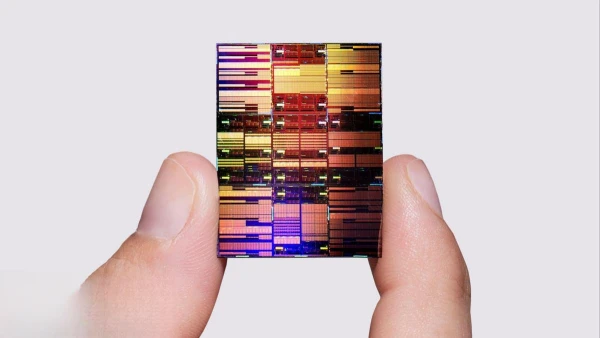
IBM's new sub-1 nm chip crams almost 100 billion transistors onto a surface the size of a fingernail
By
Technology editor
- Published 2 hours ago
IBM has unveiled a new chip design which it says could enable manufacturers to cram 100 billion transistors on a silicon chip the size of a fingernail.
The current industry-standard size for chips, measured in a the unit of nanometres - a billionth of a metre and the size of a few atoms - is around two nanometres (nm).
But IBM claims its new chip tech is the equivalent of around 0.7nm, which may make it the world's first known chip technology below 1nm.
However, it will be several years before the chip tech could be ready to go into production.
The firm claims in tests, its prototype performed 50% better than its own 2nm chip and was 70% more energy efficient.
It claimed similar boosts in performance when it debuted its 2nm chip tech back in 2021 - saying at the time its tests of those, slightly larger, chips produced similar leaps in performance and energy efficiency.
Jay Gambetta, director of IBM Research and IBM Fellow, described the NanoStack tech as a "landmark moment" for the future of chips.
"With our new NanoStack architecture, we're not just making smaller transistors, we're reinventing how chips are built to deliver dramatically more power and energy efficiency," he said.
Packing-in power
Transistors are the building blocks of silicon chips - which provide computing power for the world's electronics, including smartphones, games consoles and laptops.
They have also become crucial to the powerful computers housed in data centres, processing a range of everyday digital activities from streaming to online banking, and powering the generative AI boom.
The more transistors manufacturers can squeeze onto a chip, the more powerful the chip becomes, and therefore the more devices can do.
At the same time, designers strive to make the chips themselves ever smaller.
For decades, the number of transistors that can be put onto a chip has doubled every two years: this is a phenomenon known as Moore's Law.
But with billions of transistors now on some chips, it is growing more difficult to sustain and experts broadly agree this pace of growth cannot continue indefinitely.
Moore's Law: Beyond the first law of computing
* Published 17 April 2015
In order to try to extend it, rather than try to cram more transistors onto the surface horizontally, chip designers have for some time focused on 3D alternatives, essentially altering the shape of the transistors to make them taller.
IBM's approach is to layer sheets of them on top of each other as well.
Professor Alan Woodward, a computer scientist at Surrey University, compared it with building a big block of flats rather than houses in a city.
"IBM's NanoStack is like proposing a 100-story skyscraper," he said, adding that in his view, the firm's closest rivals such as Samsung and Intel are closer to 30-50 story buildings with their own 3D chip work.
The challenges facing 3D chip designers include heat: the transistors can get hot as they work and heat rises.
Additionally, when the layers between them are too thin, sometimes this prevents them from switching off when they're supposed to, and this stops the chip from working.
"I think it's fair to say IBM's proposals are the most ambitious," said Prof Woodward.
Sign up for our Tech Decoded newsletter to follow the world's top tech stories and trends. Outside the UK? Sign up here.
Related topics
Scientist publishes fresh doubts over Microsoft's quantum claims
* Published 21 hours ago
Nvidia announces new AI chip for personal computers
* Published 1 June
Scientists grow mini human brains to power computers
* Published 4 October 2025
The video playlist
Watch our pick of standout clips from across the BBC
Previous Next
- 0:29 Why does this heatwave feel so different? 00:00:29, play video Why does this heatwave feel so different?
- 1:33 How to keep your baby cool in a heatwave. 00:01:33, play video How to keep your baby cool in a heatwave
- 0:38 Why does it feel so much hotter than the temperature forecast? 00:00:38, play video Why does it feel so much hotter than the temperature forecast?
- 1:21'Typical Scotland' Scotland fans disappointed after 3-0 loss to Brazil. 00:01:21, play video'Typical Scotland' Scotland fans disappointed after 3-0 loss to Brazil
- 0:59'Our home was turned into a cannabis farm' 00:00:59, play video'Our home was turned into a cannabis farm'
- 1:09 When is it too hot to walk your dog? 00:01:09, play video When is it too hot to walk your dog?
- 0:57 Reeves asked why she missed Starmer's resignation. 00:00:57, play video Reeves asked why she missed Starmer's resignation
- 0:56 How did people cope during the 1976 heatwave? 00:00:56, play video How did people cope during the 1976 heatwave?
- 1:20 Don't make this mistake when applying for a job. 00:01:20, play video Don't make this mistake when applying for a job
- 1:00 How to tell if your squishy is unsafe. 00:01:00, play video How to tell if your squishy is unsafe
- 1:17 Why women are more affected by hot weather than men. 00:01:17, play video Why women are more affected by hot weather than men
- 1:14 The history of deodorant. 00:01:14, play video The history of deodorant
- 1:11 Badenoch jokes with Starmer about by-election. 00:01:11, play video Badenoch jokes with Starmer about by-election
- 0:49 The five-minute hack to feeling happier at work. 00:00:49, play video The five-minute hack to feeling happier at work
- 0:39 Why do World Cup stadiums cover up branding? 00:00:39, play video Why do World Cup stadiums cover up branding?
- 0:37 Sophie’s Med veg and tuna potato salad. 00:00:37, play video Sophie’s Med veg and tuna potato salad
- 1:18 The Irish priest who built an airport. 00:01:18, play video The Irish priest who built an airport
- 1:28 Is vaginal microbiome testing worth it? 00:01:28, play video Is vaginal microbiome testing worth it?
- 0:55 Are UK prime ministers spending less time in the job? 00:00:55, play video Are UK prime ministers spending less time in the job?
Top stories
Live. Venezuela earthquakes kill at least 164, as rescuers search collapsed buildings
* 13332 viewing 13k viewing
Watch: Moment earthquakes hit airport and buildings in Caracas
* Published 12 hours ago
Live. Temperatures top 33C and red extreme heat warning extended as heatwave grips UK
* 15899 viewing 16k viewing
More to explore
- I've spent 30 years in recruitment - this is how to get a job
- Rescuers race to find Venezuela quake survivors: What we know so far
- 'I thought I was going to die' - Venezuelans describe earthquake panic
- Banned swimmer's daughters to realise family's Commonwealth Games dream
- 'From excitement to emptiness': Families affected by largest NHS maternity scandal tell their stories
- How to cope in a heatwave - according to you
- 'It's made me really proud' - SEN pupils stepping into work
- The woman who fought for Pakistan's disappeared men now faces life in jail
- Politics Essential: Get the latest news and analysis delivered to your inbox every weekday
Elsewhere on the BBC
- The mysterious Angine de Poitrine perform Fabienk live
- An investigation into swinging raises questions about the idea of consent
- Award-winning drama on changing Britain through four friends' eyes
- Unfolding the history behind the formation of the Ku Klux Klan
Most read
- 1Education secretary says she'll turn Tory leader's insult into a T-shirt
- 2Council sorry for parking fines after train crash
- 3Bodies found in 'advanced deterioration' at under-fire trust
- 4Jail time and unlimited fines planned under conversion practices ban
- 5Trump describes Burnham as the 'mayor of a town' and 'extremely liberal'
- 6How to cope in a heatwave - according to you
- 7Find out which university degrees could earn you most across your lifetime
- 8One dead and child injured as train hits car
- 9I've spent 30 years in recruitment - this is how to get a job
- 10Banned swimmer's daughters to realise family's Commonwealth Games dream
BBC News Services
Copyright © 2026 BBC. The BBC is not responsible for the content of external sites. Read about our approach to external linking.