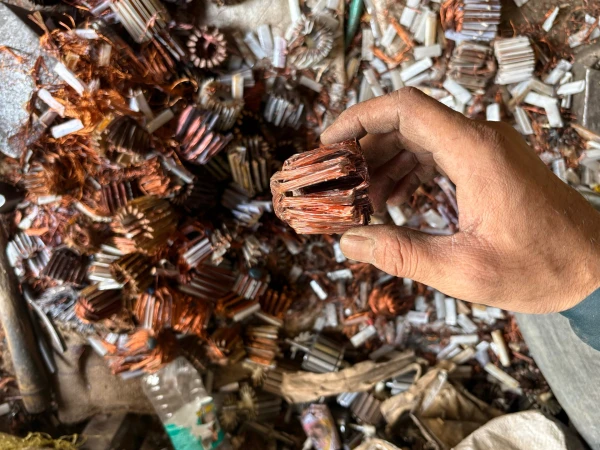
New Delhi, India – In a cramped workshop in New Delhi's Mustafabad area, Mateen Malik carefully separates copper wires from piles of discarded electronics. Around him lie broken air coolers, tangled cables, scraps of metal, and old computers stacked against blackened walls. Using his bare hands, he strips plastic coatings from wires, often resorting to blow torches to dismantle electronics—a process that releases highly toxic chemicals into the air.
"Sometimes the extraction is difficult, and I don’t have any protective gear—no gloves, no mask. Often, I get burns on my hands as well. This is routine in our job. The chemical residue is also there," Malik told Al Jazeera. "But I am dependent on this job."
Malik, in his early twenties, is an untrained, informal e-waste segregator in Mustafabad, one of India's informal waste hubs, where narrow lanes echo with hammering and the smell of burned plastic and metals. An average worker here earns about one dollar for dismantling a mobile handset and twice that for a television set, totaling roughly $8 a day for 12 grueling hours—without gloves, masks, or protective gear.
The hidden costs of such work are far greater: chronic illnesses, environmental contamination, and generations exposed to toxic substances.
'Hazardous work'
India is the world's third-largest generator of electronic waste after China and the United States, with recycled waste increasing by nearly 23 percent annually. In March, the federal minister of state for environment, forest and climate change, Kirti Vardhan Singh, told parliament that India generated more than 1.4 million metric tonnes of electronic waste in 2025-2026, of which about 979,000 metric tonnes were recycled. According to India's Central Pollution Control Board, New Delhi alone accounts for nearly 10 percent of India's total e-waste, producing an estimated 230,000 metric tonnes annually.
Behind these discarded electronics lies a sprawling network of scrap dealers, repair shops, and backyard dismantlers who often work with little awareness of the toxic risks they face. As India's digital consumption grows, the burden of managing e-waste falls largely on workers like Malik, with little protection.
Inside another small workshop, thin streams of black smoke rise as Muhammad Faizan burns insulated wires to extract copper. The walls have turned black from continuous burning. The smell of melted plastic lingers as the migrant worker from Uttar Pradesh's Bulandshahr district works with three other men.
"It is hazardous work. I sit in the same place every day from 9 in the morning to 8 at night. While dismantling electronics, I often get cuts on my hands. And when we burn plastic to extract the metal, I end up inhaling the smoke," he told Al Jazeera. "We are paid according to the amount of metal we extract."
Nearby, a group of women workers huddle in another shop, separating copper, silver, and even traces of gold from electronic chips and discarded hard drives with their bare hands. The heat inside the room is suffocating, as piles of electronics leave little space to move.
"The working conditions are tough, the space is smaller, with only a few fans that hardly provide any relief in this heat," Shakila, a 48-year-old migrant worker from West Bengal, told Al Jazeera. "We also get frequent cuts on our hands and infections." Sometimes she takes work home to complete it. "We also get paid less than men, but at least we make some money," she says.
Al Jazeera reached out to India's Ministry of Environment, Forest and Climate Change and the Delhi Pollution Control Committee regarding worker safety, but did not get a response.
Families also affected
Bharati Chaturvedi, founder and director of Chintan, an environmental research and action group, says one defining characteristic of India's informal e-waste economy is the overlap between homes and workplaces. "Very often, a worker is living on the upper floor, and dismantling is done on the ground floor or on the roof," she told Al Jazeera.
"The first thing that strikes a person is the proximity of these items, many of which are broken, thrown out with lead dust and other toxins. They can catch fire," she said. "Workers often use blow torches while dismantling them, releasing even more toxic substances into the air."
The consequences extend beyond workers. Families, including children, are frequently exposed because they live in the same spaces where e-waste is processed. "There is an impact, particularly on children, due to extreme toxins. There is a lack of accountability on improving the workers’ conditions," Chaturvedi said, describing health risks including cuts, infections, lead exposure, toxic dust, and hazardous chemicals.
According to the World Health Organization (WHO), informal recycling activities can release toxic substances like lead, mercury, cadmium, and dioxins into the environment. WHO has linked such pollutants to impaired neurological development, reduced lung function, and respiratory illnesses, especially among children living near recycling sites.
Last year, a study of informal e-waste workers in Delhi's Seelampur area found that they faced significant occupational health risks while possessing limited awareness of the hazards. Despite the risks, only about 10 percent regularly used personal protective equipment (PPE), citing cost and discomfort as main barriers.
While India has laws to regulate e-waste management, informal recyclers often flout them. Government data shows only 322 authorized e-waste recyclers, while researchers estimate the informal sector handles nearly 95 percent of the country's discarded electronics.