When Krishna Kumar pulled into a petrol station in New Delhi a few months ago, he expected nothing more than a routine fuel stop. Instead, like millions of motorists across India, he found that E20 petrol – a blend containing 20 percent ethanol – was the only fuel available.
He had little choice but to fill up.
Within weeks, the bank employee began noticing changes in the way his petrol sedan behaved on the road. Its fuel efficiency declined, acceleration became sluggish, and driving uphill or with the air conditioner on felt noticeably different. The mileage dropped from about 18-20 km per litre to 16-17 km per litre – a drop of more than 10 percent.
Kumar's plight is shared by millions of car owners across India as the country completes one of the world's fastest transitions to higher ethanol-blended petrol.
Under the National Policy on Biofuels, the government of Prime Minister Narendra Modi advanced its target of achieving 20 percent ethanol blending from 2030 to 2025. E20 became mandatory across petrol stations last year. Despite initial concerns, calls for a review of the policy died down.
But in June 2026, the government's attorney general told India's Supreme Court that the Modi administration was "experimenting" with a 20 percent ethanol blend. Although the government later claimed the attorney general had been misunderstood, the comments led to national outrage.
The government argues that E20 will reduce dependence on imported crude oil, strengthen energy security, lower greenhouse gas emissions, and create new income opportunities for farmers. But consumers point to dropped mileage – a claim that Union Transport Minister Nitin Gadkari has accepted – and some allege damage to car parts. Opposition parties have accused Gadkari of a potential conflict of interest, as his family is involved in ethanol production.
At the heart of the debate is a single question: Why has the government pushed through this fuel in such a rush?
Less powerful cars
Supporters describe the initiative as a key milestone in India's clean-energy transition. Critics argue that consumers are experiencing immediate costs through lower fuel efficiency, compatibility concerns, and uncertainty over long-term maintenance.
The rollout raises questions about millions of older petrol vehicles on Indian roads. Automakers began introducing E20-compatible materials in new vehicles from 2023, and fully compliant models entered the market from 2025. The government says older vehicles can safely use E20 with routine maintenance, but many owners remain unsure.
Anas Khan, a New Delhi businessman, drives a 2021 Maruti Suzuki Baleno. "I have definitely noticed a drop in mileage," he said. "Earlier, my car used to give about 18 km per litre, but now it is down to nearly 15 km per litre. The pick-up has also become slower."
According to independent automobile expert Sajad Ahmad Wani, the effects depend on vehicle design and age. "Vehicles that are not E20-compatible are unlikely to develop problems immediately, but with continuous use, ethanol can accelerate wear of rubber hoses, seals, gaskets, and other fuel system components. Motorists may also notice a slight drop in mileage."
Ethanol contains less energy per litre than conventional petrol, so engines generally require more fuel to produce the same power. While government agencies describe the reduction as marginal for compatible vehicles, experts say the actual impact varies.
Wani said many motorists "still do not know whether their vehicles are E20-compatible or what changes they should realistically expect." Car manufacturers and government agencies, he said, need to do more to communicate with vehicle owners.
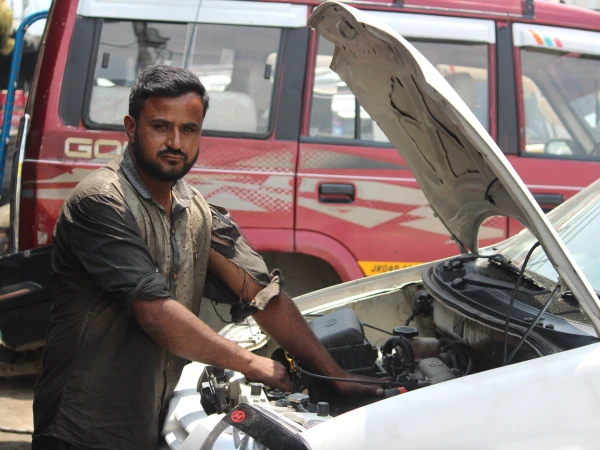
Bilal Ahmad, a mechanic, said he has recently seen more customers reporting reduced mileage and engine performance. "From my experience, there seems to be a connection between the newer fuel and the problems some petrol vehicle owners are facing."
Long-term impact
The Indian government has disputed most concerns. The Ministry of Petroleum and Natural Gas said assertions that E20 harms engines or substantially reduces mileage are "largely unfounded and not supported by scientific evidence." It cited studies by ARAI, IIP, and oil companies showing no significant differences in performance, power output, or engine wear, including in older vehicles. The ministry said compatible four-wheelers experience only a marginal 1-2 percent reduction in efficiency and that any material degradation can be addressed through routine replacement of rubber components.
Union Transport Minister Nitin Gadkari has strongly defended the ethanol policy.