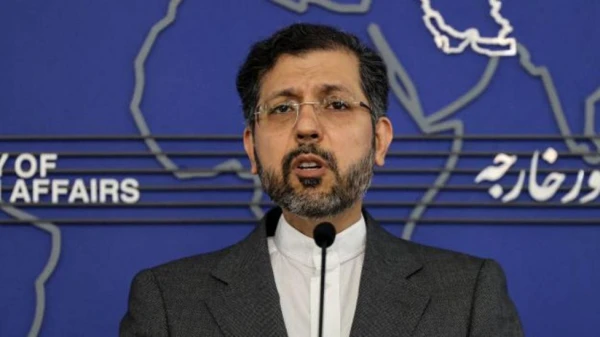
Iran's Deputy Foreign Minister Saeed Khatibzadeh has declared that Israeli military actions in Lebanon represent a "grave violation" of the newly established US-Iran ceasefire agreement, intensifying regional tensions just one day after the deal was struck.
In an exclusive interview with BBC Radio 4's Today programme, Khatibzadeh asserted that the two-week ceasefire explicitly includes Lebanon—a claim disputed by both the United States and Israel. He delivered a stark ultimatum to Washington, stating, "The US must choose between war and ceasefire. You cannot ask for a ceasefire and then accept terms and conditions, and then your ally just starts a massacre."
"You cannot have cake and eat it at the same time," Khatibzadeh summarized Tehran's message to the White House, delivered late Wednesday.
The Lebanese health ministry reports at least 203 fatalities from Wednesday's Israeli air strikes, which targeted what Israel described as Hezbollah command centers and military installations. Despite the violence, Khatibzadeh maintained that Hezbollah—the Iranian-backed militant group—has "abided" by the ceasefire terms, though Hezbollah itself claimed Thursday it fired rockets at Israel overnight in response to "ceasefire violations."
The Iranian minister also addressed maritime security concerns, defending Tehran's warning that ships passing through the Strait of Hormuz without permission "would be targeted and destroyed." He argued the vital waterway comprises Iranian and Omani territorial waters and that both nations have historically allowed safe passage through "goodwill."
Khatibzadeh stated Iran would "provide security for safe passage" if the US withdrew its "aggression," but emphasized the need to develop an international protocol to prevent misuse by warships. The strait, through which approximately one-fifth of global oil and liquefied natural gas typically flows, has been effectively blocked by Iran since the conflict began on February 28, causing significant economic disruption worldwide.
White House spokesperson Karoline Leavitt contradicted reports of the strait's closure, noting an "uptick" in maritime traffic, while President Trump emphasized US forces would remain in the region until the "real agreement" with Iran was honored, specifically requiring the strait be "open and safe."
Expressing skepticism about reaching a permanent understanding with Washington, Khatibzadeh accused the US of using negotiations as "a cover for military action." When questioned about upcoming US-Iran talks scheduled in Pakistan, he responded cautiously: "We are going to closely monitor what is happening from now on."
Despite his doubts, the Iranian diplomat added, "As a diplomat, I'm very much hopeful that finally we reach an understanding and settle this within our national interest and within the regional interest."