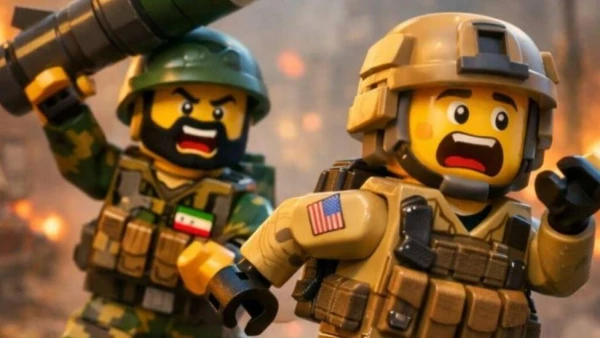
At first glance, they resemble scenes from a vibrant Lego movie—colorful, fast-paced, and visually striking. Yet these viral AI-generated videos, crafted in the instantly recognizable Lego aesthetic, depict dying children, fighter jets, and U.S. President Donald Trump, serving as sophisticated pro-Iran propaganda.
For an exclusive interview, we spoke with a representative from Explosive Media, a key account behind these clips, who asked to be identified as Mr. Explosive. A savvy social media operator, he initially denied ties to the Iranian government, echoing previous claims of independence. However, under further questioning, he admitted the regime is a "customer"—a revelation never before confirmed publicly.
The core message of these videos is clear: Iran is resisting what it portrays as a global oppressor, the United States. Despite their garish and unsubtle style, the clips have spread rapidly, amassing hundreds of millions of views since the U.S.-Iran war began in February.
"Slopaganda'—a term coined last year as a play on 'AI slop'—is too weak to capture how powerful this 'highly sophisticated' content is," says leading propaganda expert Dr. Emma Briant.
In one video, Donald Trump tumbles through a whirlwind of "Epstein file" documents, accompanied by rap lyrics declaring, "the secrets are leaking, the pressure is rising." Another shows George Floyd under a policeman's boot, with a voiceover claiming Iran "stands here for everyone your system ever wronged."
During our video call, Mr. Explosive appeared silhouetted against red and green lights—the colors of the Iranian flag—with a green-feathered helmet on his desk, symbolizing Shia warrior Husayn ibn Ali. He explained that his team of fewer than ten uses Lego-style graphics "because it is a world language," with Iranian and Russian state media accounts regularly sharing the videos to millions of followers.
When asked about the heavy focus on Epstein files, Mr. Explosive stated it highlights the "confrontation" between Iran, which "seeks truth and freedom," and "those who associate themselves with cannibals." This references baseless theories linking the Trump administration to cannibalism, for which no credible evidence exists.
The videos are also riddled with factual inaccuracies. One clip depicts the Iranian military capturing a downed U.S. fighter-jet pilot, despite U.S. officials confirming the airman was rescued by special forces on April 4. Mr. Explosive dismissed this, claiming, "Possibly there was no lost pilot... Their main goal was to steal uranium from Iran." When challenged, he retorted, "Only 13% of what Mr. Trump says is based on facts."
This alternative narrative has gained traction among English-speaking audiences. A U.S.-based TikTok influencer, @newswithsteph, told followers the Lego videos were "shockingly accurate," alleging the pilot mission was actually a "special ops mission for uranium."
Dr. Briant notes that AI enables Iran to communicate directly with Western audiences more effectively than ever, using tools trained on Western data to create "culturally appropriate" content—something authoritarian regimes have historically lacked.
Dr. Tine Munk, a cyber warfare expert at Nottingham Trent University, describes Iran's approach as "defensive memetic warfare," seen as necessary to counter U.S. rhetoric.
Explosive Media's videos first emerged in early 2025, with popularity surging after the war's outbreak. The clips have grown increasingly detailed, showing specific Gulf locations like power stations and airports being destroyed by Iranian missiles, though in reality, most sustained only limited damage. Produced in "real time," they often appear swiftly after major developments; one video on a ceasefire agreement was published before official announcements.
As the conflict has escalated, thousands have been killed in Iran, Lebanon, and other Middle Eastern nations, according to local officials. Mr. Explosive defended his team's government ties, calling it "honorable to work for the homeland," and dismissed recent mass protests—where thousands of civilians were killed in a regime crackdown—as a Trump-funded "coup."
He also rejected allegations of antisemitism in the videos, stating, "Our videos are not antisemitic; they are anti-Zionist," and justified depictions of Israeli Prime Minister Benjamin Netanyahu drinking blood as highlighting "atrocities committed by him."
With most Iranians offline due to nationwide internet shutdowns, these AI-driven narratives continue to shape perceptions abroad, marking a new frontier in digital propaganda warfare.