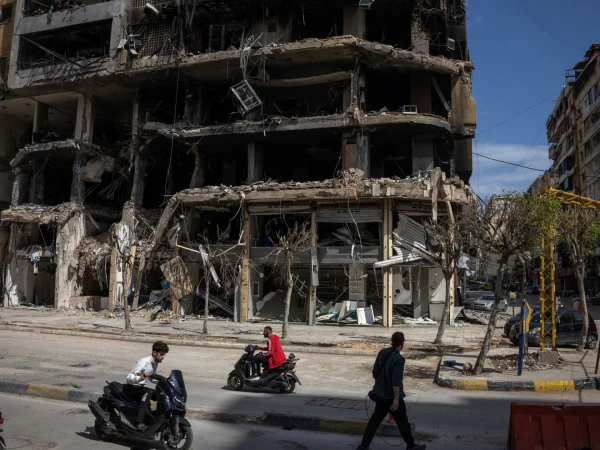
Israeli attacks have killed at least four people in southern Lebanon's Nabatieh district, according to the state news agency, as Israel continues its military operations despite a three-week extension of a ceasefire with Hezbollah.
The Lebanese Ministry of Public Health's emergency operations center reported that two Israeli raids targeted a truck and a motorcycle in the town of Yohmor al-Shaqif, resulting in four deaths, the Lebanese National News Agency reported.
Al Jazeera's Heidi Pett, reporting from Tyre, said the attacks occurred north of the Litani River, an area where Israel has unilaterally declared it is operating. Meanwhile, in Bint Jbeil, Israeli soldiers reportedly blew up buildings on Saturday morning. Al Jazeera correspondents also reported bombings in Khiam, including on residential blocks.
Pett described the ongoing violence as "part of a continued pattern of Israeli military activity, despite what is ostensibly a ceasefire," noting that the "rumble and thud of explosions" could be heard across southern Lebanon. "That is Israel demolishing houses and buildings," she said.
According to Lebanon's Ministry of Public Health, Israeli attacks since March 2 have killed 2,496 people and wounded 7,719.
The attacks come after US President Donald Trump announced a ceasefire extension on Thursday. Within hours, the Israeli military claimed it had "eliminated" six Hezbollah fighters in an exchange of fire near Bint Jbeil.
Hezbollah lawmaker Ali Fayyad called the ceasefire "meaningless in light of Israel's insistence on hostile acts, including assassinations, shelling, and gunfire," adding that Hezbollah retains the "right to retaliate."
Israeli Prime Minister Benjamin Netanyahu said Israel was "maintaining full freedom of action against any threat" and claimed Hezbollah was "trying to sabotage" the pause.
Analysts say the ceasefire arrangement has failed to halt hostilities and may never have been intended to do so. Ali Rizk, a security affairs analyst in Beirut, told Al Jazeera: "We have to remember that this was a ceasefire between the Lebanese state and the Israeli state. We've had Hezbollah parliamentarians say that this ceasefire doesn't concern them."
Rizk said the process initiated by Washington has been viewed with skepticism in Lebanon. "It's been seen as an attempt to take aim at Hezbollah, first and foremost, more than actually being about real peace or real calm," he said. He added that "the ceasefire basically never existed to begin with. It was an arrangement reached between Israeli officials to allow for these negotiations, and the number one of these negotiations is to dismantle Hezbollah."
Israel has warned residents not to approach areas near the Litani River, where its forces remain deployed, reinforcing its continued military presence on Lebanese territory.
Before Trump's ceasefire announcement, a poll by the Israel Democracy Institute suggested that Jewish Israeli respondents overwhelmingly supported continuing the conflict, even if it led to friction with the US.
The Lebanese leadership has rejected the possibility of Lebanon being used as a "bargaining chip" amid potential US-Israel negotiations with Iran, Pett said.
Lebanese civilians are facing the fallout. Huda Kamal Mansour, from Aitaroun village, has been living with her nine-year-old son in an empty stadium in Beirut along with other displaced families for the past 45 days. She told Al Jazeera she ran for her life when the Israeli army started bombarding her neighborhood. "There was zero distance between us and the Israeli army when they attacked southern Lebanon. All I could hear was the sound of explosions hitting villages. We were told to evacuate from the village, then the tanks surrounded us," she recalled. "Israel didn't leave one house standing there."