5 hours ago
Josh Parry LGBT & Identity Reporter
Getty Images
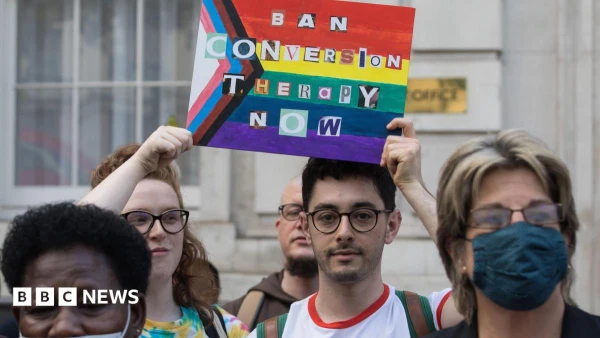
Plans to ban conversion practices were first promised in 2018 but led to protests after several U-turns
Those who carry out conversion practices - commonly known as "conversion therapy" - could be jailed for up to five years under landmark new plans.
The draft Conversion Practices Bill, which criminalises "abusive acts" aiming to change someone's sexual orientation or transgender identity, is expected to be laid before Parliament later today.
The Cabinet Office said the Bill will ensure LGBT+ people are "protected from physical and psychological abuse to change who they are".
Some groups have raised concerns such laws could criminalise exploratory conversations around gender identity or sexual orientation.
The government says it is proposing to legislate because existing domestic abuse or coercive control laws do not address "the unique nature of abusive conversion practices".
The plans - which apply to England and Wales - will, for the first time, set a legal definition of conversion practices as conduct which "aims to change someone's sexual orientation or transgender identity through abusive acts that seriously harm the victim".
Minister for Equalities Olivia Bailey said: "Conversion practices are driven by the false belief that being LGBT+ is shameful and can be forcibly changed.
"Legal loopholes have left LGBT+ people vulnerable to these harmful acts, which is why we must legislate."
Two new criminal offences will be created under the plans: one for carrying out conversion practices "which cause serious harm, alarm or distress", and another for encouraging or assisting such practices to take place outside of England and Wales.
Proposals also include new civil powers known as Conversion Practice Protection Orders, which they say will "pre-emptively protect those deemed to be at risk of abuse".
Those found guilty of conducting abusive conversion practices could face both an unlimited fine and prison sentences of up to five years.
How prevalent are conversion practices?
It's difficult to know exactly how widespread conversion practices are.
About 5% of the 108,000 people who responded to the government's UK-wide LGBT Survey in 2018 said they had been offered some form of conversion therapy, while 2% had undergone it.
But the survey did not define what it meant by conversion therapy, and did not ask when or where it had happened.
Galop, an anti-LGBT abuse charity which has campaigned in favour of a ban, has today released new figures and says between 2022 and 2025 it identified more than 300 calls about conversion practices.
Researchers analysed a sample of 195 of those calls and found reported examples of physical and sexual violence, attempts at forced marriages and people being forcibly taken abroad to undergo conversion practices.
The majority of cases (132) were reported as ongoing or recent, and more than half (123) were reported as being initiated by parents.
Many cases involved more than one type of reported conversion practice, with Galop finding:
- 158 cases involving coercive and controlling behaviour
- 52 cases of religion-based conversion practices, including forced or coerced prayer, religious "aversion therapy" and exorcisms
- 47 cases involving physical violence
Legislation to ban conversion practices was first promised in 2018, but was subject to several government U-turns and the resignation of the government's LGBT+ Advisory Panel.
The BBC understands that advisors had previously failed to reach a consensus over whether bringing in legislation risked criminalising parents or professionals who had exploratory conversations with young people experiencing gender-related distress.
The government says the draft proposals include exemptions for legitimate healthcare, and set a "high threshold" for criminality so that "only acts that are abusive, seeking to change someone's identity" will be covered by the law.
Dr Hilary Cass, author of a landmark report into children's gender identity services, said it was important the legislation allowed healthcare professionals to do their job "without fear of litigation".
She said: "I am pleased to see that the government is bringing forward legislation which not only gives a clearer definition of what conversion practices are, compared to previous drafts, but also what they are not."
Mary-Ann Stephenson, Chair of the Equality and Human Rights Commission, said it's "crucial" the legislation has "clear definitions and boundaries" to protect legitimate medical treatment and therapy and to make sure religious freedoms are not "disproportionately restricted."
The proposals will likely lead to intense scrutiny, both from campaigners who say the legislation is long-overdue, and from those who have concerns over the potential unintended consequences of a ban.
Andrea Minichiello Williams, chief executive of the Christian Legal Centre, says any legislation brought forward would "needlessly restrict freedom of speech and prayer".
She told the BBC the legislation would have a "chilling impact" on therapists and religious leaders attempting to support people with questions around their sex or gender.
Andrea Minichiello Williams
Andrea Minichiello Williams, chief executive of the Christian Legal Centre, says the organisation will bring legal action over any ban
She said: "Genuinely abusive and harmful practices are already illegal in the UK. A new ban would target prayer and consensual conversations that many people find beneficial.
"The counselling room and the pastor's room are places that should be free for them to explore that fully."
Williams told the BBC she will launch a legal challenge against any law banning conversion practices.
Baptist minister Justin Kennedy, who says he underwent conversion practices in his early 20s, says a ban will help prevent harm.
He told the BBC he was left suicidal after spending six years undergoing "deliverance therapy", where pastors would pray over him to "clear out demons" and try to blame "past trauma" for his sexuality.
Justin Kennedy
Justin Kennedy says conversion practices left him with life-long issues
He said: "When somebody that you respect, and who you believe holds knowledge of God tries to rewire you, the knock-on effects are absolutely drastic.
"The only thing I lost through deliverance therapy was my faith, and what came in its place was shame and suicidal ideation."
The BBC understands a process of pre-legislative scrutiny for the bill will begin in the coming weeks, and is expected to last around three months.
It will then need to go through several stages in the House of Commons, where MPs can table and vote on amendments, and the House of Lords before it can become law.