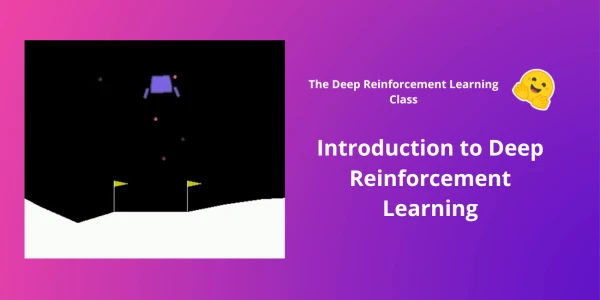
Deep Reinforcement Learning (Deep RL) is one of the most exciting frontiers in artificial intelligence. It combines reinforcement learning with deep neural networks to enable agents to learn optimal behaviors through trial and error in complex environments.
What is Reinforcement Learning?
Reinforcement Learning (RL) is a type of machine learning where an agent learns to make decisions by interacting with its environment. The agent takes actions, observes the results, and receives rewards or penalties. The goal is to maximize cumulative reward over time.
The Big Picture
Imagine a baby learning to walk. Each step might result in a stumble (negative reward) or a successful step (positive reward). Over time, the baby learns which movements lead to walking. RL formalizes this trial-and-error learning process.
Formal Definition
In RL, we define:
- Agent: The learner or decision-maker.
- Environment: The world the agent interacts with.
- Action: A move the agent can make.
- State: The current situation of the environment.
- Reward: Feedback from the environment.
The agent's objective is to learn a policy—a mapping from states to actions—that maximizes the expected cumulative reward.
The Reinforcement Learning Framework
The RL Process
At each time step:
- The agent observes the environment's state.
- It selects an action based on its policy.
- The environment transitions to a new state and gives a reward.
- The agent updates its knowledge.
This loop continues until the agent reaches a terminal state or a maximum number of steps.
The Reward Hypothesis
The central idea of RL is that all goals can be described as maximizing expected cumulative reward. This is known as the reward hypothesis.
Markov Property
A problem satisfies the Markov property if the future state depends only on the current state, not on the past history. Most RL problems assume this property for tractability.
Observations/State Space
The state space is the set of all possible states the environment can be in. Observations can be fully observed (agent sees the complete state) or partially observed (agent sees only a subset).
Action Space
The action space is the set of all possible actions. It can be discrete (e.g., left/right) or continuous (e.g., steering angle).
Rewards and Discounting
Rewards are immediate feedback. To avoid myopia, we use discounting: future rewards are multiplied by a discount factor γ (0 < γ ≤ 1) to value immediate rewards more.
Types of Tasks
- Episodic: Tasks that have a clear end (e.g., a game level).
- Continuing: Tasks that go on forever (e.g., a robot vacuum).
Exploration vs. Exploitation
This tradeoff is fundamental: should the agent try new actions to discover better rewards (exploration) or stick with known good actions (exploitation)? Balancing both is critical for learning.
Two Main Approaches for Solving RL Problems
The Policy π: The Agent's Brain
The policy is the agent's strategy. It can be deterministic (always choose the same action in a state) or stochastic (probability distribution over actions).
Policy-Based Methods
These methods directly optimize the policy. Examples include:
- REINFORCE: A Monte Carlo policy gradient method.
- Proximal Policy Optimization (PPO): A stable, popular algorithm.
Value-Based Methods
These methods learn a value function that estimates how good it is to be in a state (or to take an action in a state). The agent then chooses actions that maximize this value. Examples:
- Q-Learning: Learns the optimal action-value function.
- Deep Q-Networks (DQN): Uses neural networks to approximate Q-values.
The "Deep" in Deep Reinforcement Learning
Deep RL uses deep neural networks to handle high-dimensional state spaces (like images). DQN was a breakthrough: it used a CNN to play Atari games directly from pixels. Since then, deep RL has achieved superhuman performance in games like Go and Dota 2, and is used in robotics, healthcare, and more.
Getting Started with the Deep RL Class
This article is the first unit of the free Deep Reinforcement Learning Class, where you'll learn both theory and practice. You'll use libraries like Stable Baselines3 and RLlib to train agents in environments like SnowballFight and Space Invaders. You'll also learn to publish agents on the Hugging Face Hub.
Start your journey today by mastering these foundations—the first step to building intelligent, autonomous agents.