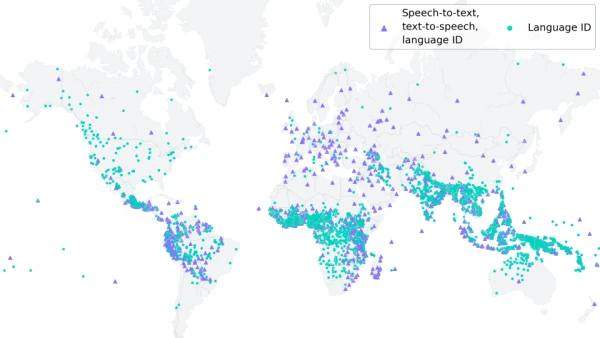
Meta AI's Massively Multilingual Speech (MMS) model represents a breakthrough in automatic speech recognition (ASR), capable of transcribing over 1,100 languages. The key innovation lies in its adapter-based fine-tuning approach, which allows users to achieve remarkably low word error rates after just 10-20 minutes of training on a new language.
What Are Adapters?
Adapters are small, trainable modules inserted between the layers of a pre-trained model. Instead of retraining the entire model—which can have hundreds of millions of parameters—adapters update only a tiny fraction of weights. For MMS, each language-specific adapter contains just ~2.5 million parameters, made of linear projection layers for attention blocks and a language-specific output layer. This makes fine-tuning incredibly efficient and memory-friendly.
Compared to full model fine-tuning (as done previously with XLS-R), adapter training is more robust and yields better performance for low-resource languages. For medium to high-resource languages, full fine-tuning may still be advantageous, but for endangered or low-resource languages, adapters are strongly recommended.
Preserving Linguistic Diversity
According to Ethnologue, around 3,000 languages—40% of all living languages—are endangered. MMS can transcribe many such languages, including Ari and Kaivi, offering a way for remaining speakers to create written records and communicate in their native tongues. By using adapters, a single large base model can serve hundreds of languages, each with its own lightweight adapter.
How MMS Was Pre-Trained
MMS unsupervised checkpoints were pre-trained on over half a million hours of audio in more than 1,400 languages. Models range from 300 million to 1 billion parameters. The pre-training objective is similar to BERT's masked language modeling: the model learns contextualized speech representations by randomly masking feature vectors and predicting them.
For ASR, the MMS-1B checkpoint was further fine-tuned on 1,000+ languages with a joint vocabulary output layer. That layer was later discarded and replaced with language-specific adapter layers, each with ~2.5M weights.
Available MMS Checkpoints
Three ASR fine-tuned checkpoints are available on Hugging Face Hub:
mms-1b-fl102(102 languages)mms-1b-l1107(1,107 languages)mms-1b-all(1,162 languages)
Each repository contains a base model file (model.safetensors) and numerous adapter files (e.g., adapter.fra.safetensors for French).
Training Adaptive Weights
Adapters have a long history in speech recognition, particularly for speaker adaptation. MMS extends this idea to cross-lingual ASR. By training only the adapter weights, the model grasps unique phonetic and grammatical traits of each target language without forgetting the base model's knowledge.
In practice, you can take any of the released ASR checkpoints and fine-tune an adapter for your target language using a small dataset (e.g., Common Voice). The process is memory efficient and can be run on a single GPU.
Next Steps
For a hands-on guide, refer to the original blog post and the accompanying Colab notebook, which walks through fine-tuning MMS adapters on Common Voice data. With this approach, even languages with limited data can benefit from state-of-the-art ASR.