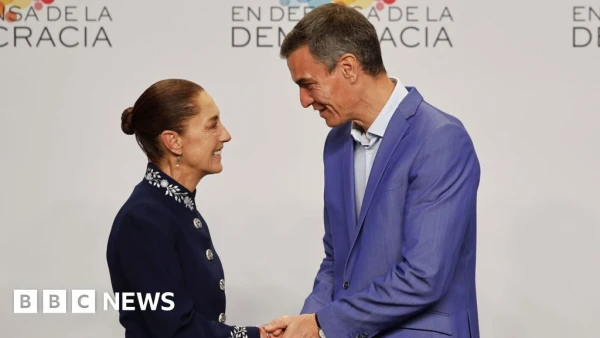
Mexican President Claudia Sheinbaum has firmly dismissed suggestions of a diplomatic crisis with Spain, despite years of strained relations stemming from historical tensions over Spain's colonial conquest of Mexico.
"There is no diplomatic crisis. There never has been," Sheinbaum stated upon arriving at a summit of left-leaning leaders in Barcelona on Saturday. "What is very important is that we recognise the strength of our country's indigenous peoples."
Spain's colonization of Mexico has emerged as a contentious issue in recent years, leading to calls for formal apologies and creating diplomatic friction between the two nations. Sheinbaum's visit marks the first by a Mexican president in eight years, signaling a potential thaw in relations.
Relations notably deteriorated in 2019 when Sheinbaum's predecessor, Andrés Manuel López Obrador, demanded that Spain apologize for human rights violations during its conquest. When Spain didn't respond, Sheinbaum made the unusual decision not to invite Spain's King Felipe VI to her 2024 inauguration, prompting Spain to refuse sending any representative.
Recent months have shown signs of reconciliation. In March, King Felipe acknowledged that "there had been a lot of abuse" during Spain's conquest of what would become Mexico, stating: "There are things that, when we study them, with our present-day criteria, our values, obviously cannot make us feel proud." This marked the first time a Spanish monarch publicly acknowledged abuses during the colonial era.
A month prior to these comments, it emerged that Sheinbaum had invited King Felipe to the upcoming FIFA World Cup, which Mexico will co-host with the United States and Canada. According to the Spanish royal palace, Sheinbaum said the sporting event would provide "a timely opportunity to evoke the depth and unique character of the ties between Mexico and Spain."
Spain's Foreign Minister José Manuel Albares also contributed to the warming relations last October when he acknowledged "pain and injustice" in the countries' shared history, earning praise from Sheinbaum.
Spain's economy minister told Reuters that Sheinbaum's presence at the Barcelona summit represented "a very important and positive sign of a rapprochement between the two countries." Sheinbaum met with Spanish Prime Minister Pedro Sánchez at the summit, though Sánchez made no public comment about the state of bilateral relations.
The Barcelona gathering, titled "In Defence of Democracy," brought together left-leaning leaders to address rising illiberalism worldwide. "Democracy cannot be taken for granted," Sánchez warned during the summit. "We are witnessing attacks on the multilateral system, one attempt after another to challenge the rules of international law, and a dangerous normalisation of the use of force."
Brazilian President Luiz Inácio Lula da Silva, co-chairing the summit with Sánchez, criticized the UN Security Council's five permanent members—the United States, China, Russia, France, and the United Kingdom—saying they had become "lords of war" through their veto powers. "No president of any country in the world, however powerful, has the right to keep imposing rules on other countries," Lula asserted.
Following their discussions, the leaders of Brazil, Mexico, and Spain issued a joint statement pledging to increase aid deliveries to Cuba, which they described as experiencing a "humanitarian crisis." The Caribbean nation has recently faced nationwide blackouts exacerbated by fuel shortages.
Meanwhile, in Milan, thousands gathered for a rally organized by the Patriots for Europe party, a right-wing grouping in the European Parliament. The event featured speeches from France's far-right Rassemblement National leader Jordan Bardella, Italy's Deputy Prime Minister Matteo Salvini, and Dutch far-right PVV leader Geert Wilders.
Bardella highlighted immigration and what he called "ever-increasing regulations imposed by the European Commission and the European Union on European industry and on the economies of the eurozone" as key issues. Salvini told the crowd that "the Alliance of Patriots is the only true adversary for the Brussels bureaucrats who serve a few businessmen and warmongers."
Notably absent was Hungary's outgoing leader Viktor Orbán, whose Fidesz party belongs to the Patriots for Europe alliance. Orbán was recently ousted in Hungary's general election by former ally Péter Magyar.