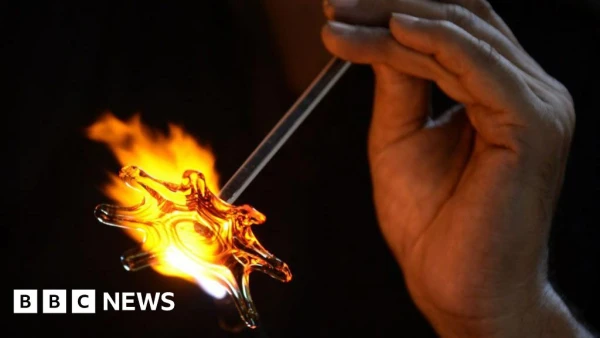
Tensions in the Middle East are sending shockwaves through India's 'glass city' Firozabad, where thousands of livelihoods hang in the balance as natural gas supplies grow scarce and costly.
Firozabad, located about 50km from the Taj Mahal in Uttar Pradesh, produces 70% of India's glass. The industry employs around 150,000 people, most earning between 500 and 1,000 rupees ($5.29 to $10.58) per day—incomes with little buffer against rising costs.
Glassmaking relies on a steady supply of natural gas to keep furnaces running at extreme temperatures. Disruptions in the Middle East, particularly around the Strait of Hormuz—through which nearly half of India's gas imports pass—have caused supply uncertainty and price hikes. Although some shipments have resumed, factory owners say relief has not reached them.
Sanjay Jain, who has run a glass bangle unit for four decades, reports a sharp drop in production after the Indian government cut commercial gas supplies by 20% to manage the squeeze. "These furnaces have to keep running—if they cool, they can be damaged," he said, adding that restarting them is "time-consuming and expensive." To ration gas, he now keeps furnaces at lower temperatures and halts production for three to four days at a time.
More than 400 small manufacturing clusters in Firozabad produce glass items ranging from car headlamp covers to chandeliers, feeding a domestic market worth over $200 million. Some owners report losses of 25-40% since the conflict began, and they fear for their future if supplies remain unstable.
Beyond gas shortages, the cost of raw materials has soared. Chemical components sourced from across India and the Middle East have become pricier due to disrupted fuel supplies and imports, according to Mukesh Bansal of the All India Glass Manufacturers' Federation. His business has seen losses of over 45%. Exports have also suffered as higher shipping costs make decorative glass items more expensive to send abroad, especially to the US.
The federal government says it "recognises the need for uninterrupted furnace operations" and is taking steps to manage supplies. Yet economist Arun Kumar warns that many small units cannot cope. "Since the labour-intensive sectors are small and micro units with only a little working capital, they are not able to cope with the shortages," he said. "If this goes on, these units are at risk of shutting down."
The situation reflects the fragility of India's small and medium-sized sector, which accounts for about 30% of GDP and employs hundreds of millions. Disruptions directly impact low-wage workers already grappling with rising living costs. A recent UN Development Programme report warns the conflict could push as many as 2.5 million people in India into poverty.
Frustration boiled over earlier this month when thousands of factory workers in northern India blocked roads demanding higher wages. The protests turned violent in parts of Uttar Pradesh. The state announced a temporary wage increase, but workers said it fell short.
For now, workers in Firozabad live with uncertainty. Umesh Babu, 35, spends long hours making bangles in sweltering conditions under a tin roof, with a furnace burning at over 1,000°C. He and others worry that if gas supplies don't return to normal, their jobs will disappear.