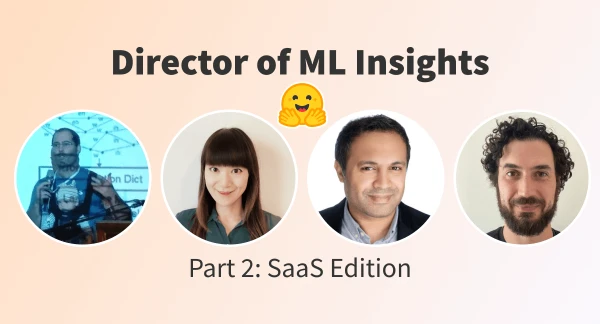
In the second installment of our Director of Machine Learning Insights series, we dive into the SaaS sector with perspectives from leaders at Salesforce, ZoomInfo, and other major companies. They share how ML is transforming automation, reducing code complexity, and improving forecasting—while also cautioning against common integration mistakes.
Omar Rahman (Salesforce)
How has ML made a positive impact on SaaS? ML has driven automation in tasks like service ticket routing via NLP, reduced code complexity compared to rule-based systems, and enabled better forecasting for cost savings.
What are the biggest ML challenges within SaaS? Productizing ML requires more than just a good model—it demands robust serving, detection, and adaptation infrastructure. Data quality and scalability also remain hurdles.
Cao (Danica) Xiao (ZoomInfo)
How has ML made a positive impact on SaaS? ML has enhanced data enrichment and lead scoring, enabling more precise targeting and higher conversion rates. Natural language processing has also improved customer support automation.
What are the biggest ML challenges within SaaS? Data labeling and annotation remain time-consuming and expensive. Additionally, ensuring model explainability to build trust with clients is a key challenge.
Raphael Cohen (Entrepreneur)
How has ML made a positive impact on SaaS? ML has allowed SaaS platforms to offer personalized experiences at scale, from content recommendations to dynamic pricing. It also powers predictive analytics that help businesses make proactive decisions.
What’s a common mistake you see people make trying to integrate ML into SaaS? Many jump to complex models without first solving the data pipeline and infrastructure issues. Simple, well-engineered solutions often outperform over-engineered models.
Martin Ostrovsky (Security Expert)
Favorite ML business application? Anomaly detection in cybersecurity—ML can identify subtle patterns of malicious activity that traditional rule-based systems miss.
What is your biggest ML challenge? Dealing with adversarial attacks: bad actors actively try to fool ML models, so robustness is a constant battle.
Where do you see ML having the biggest impact in the next 5-10 years? In autonomous decision-making systems that combine multiple ML models to act without human intervention, especially in cybersecurity and supply chain management.
These directors emphasize that while ML offers immense value for SaaS, success hinges on solid data foundations, infrastructure, and a focus on solving real business problems rather than chasing the latest algorithms.