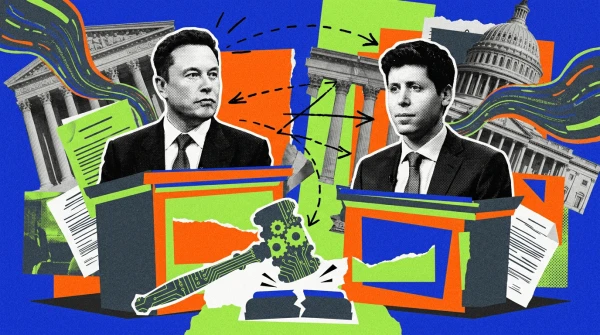
The highly anticipated trial between Elon Musk and OpenAI CEO Sam Altman opened in federal court in Oakland, with both sides presenting starkly different accounts of the AI lab's origins.
Musk likened OpenAI's shift to a for-profit company to one of history's greatest heists. "This lawsuit is very simple: It is not OK to steal a charity," Musk testified. He warned that without intervention, the case would "give license to looting every charity in America."
OpenAI's lead counsel William Savitt countered, portraying Musk as a greedy capitalist who tried to seize control of OpenAI and left when rebuffed. "We are here because Musk didn't get his way at OpenAI," Savitt said. "My clients had the nerve to go on and succeed without him."
The nine-person jury, presided over by Judge Yvonne Gonzalez Rogers, will hear from former board members, employees, and tech executives over the trial, expected to last about a month. Musk seeks $150 billion in damages and an order to unwind OpenAI's restructuring, completed in October.
Dueling Emails Over the Profit Question
Musk pointed to a conversation with Google co-founder Larry Page as the catalyst for OpenAI. Page had called him a "speciesist" for prioritizing humans over future digital life. "I wanted a company to be a counterweight to Google," Musk said, claiming he coined the name, recruited key people, and provided funding.
Savitt countered with early emails. In 2015, Musk wrote that "it's probably better to have a standard C corp with a parallel nonprofit." A year later, he said OpenAI's nonprofit structure might have been a mistake given DeepMind's progress. By 2017, as the founders realized their need for massive computing power, Musk allegedly tried to "turn OpenAI into a full-on for-profit company and take absolute control," Savitt said. The other founders, he added, "refused to turn the keys of artificial intelligence over to one person."
Musk acknowledged he was open to a for-profit subsidiary, but only with capped profits flowing back to the nonprofit. One proposal would have split equity equally among Musk, Altman, Greg Brockman, and Ilya Sutskever. Musk called that "unfair and inappropriate," noting he had been "providing all of the funding." He said he left because the others wanted too much equity.
Microsoft's Role and the Timing of Musk's Outrage
Musk's attorney Steven Molo accused Microsoft of being a willing accomplice when it invested $13 billion in OpenAI in 2019, calling it "an absolute mockery of OpenAI's charitable mission." Microsoft attorney Russell Cohen pushed back, saying "unlike Mr. Musk, Microsoft never tried to control OpenAI."
Savitt argued the lawsuit is really about Musk trying to hobble a rival to his own AI company, xAI. After leaving in 2018, Musk showed no interest in OpenAI for years, even after Microsoft's billion-dollar investment. Only after ChatGPT's success in 2022 did "the sour grapes kick in," Savitt said.
The nonprofit, now the OpenAI Foundation, still controls the company and holds 26% equity. Microsoft holds 27%. The jury will deliver an advisory verdict, but Judge Gonzalez Rogers will make the final ruling.
Before opening statements, the judge instructed Musk to "control your propensity to use social media to make things worse outside this courtroom." Musk had been mocking Altman as "Scam Altman" on X and amplifying a critical New Yorker investigation. In court, Musk, Altman, and Brockman agreed to a "clean slate beginning today" and pledged to minimize social media activity about the trial.
Security at the courthouse was heightened after a man, reportedly hostile toward AI, was arrested for allegedly throwing a firebomb at Altman's San Francisco home. Both Musk and Altman entered through a private entrance.