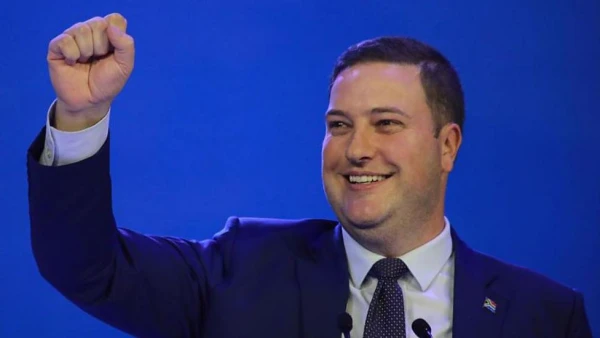
South Africa's Democratic Alliance, the country's second-largest political party, has elected a new leader tasked with solving a persistent problem: expanding its appeal beyond its traditional base of white and minority voters to attract the nation's black majority.
Geordin Hill-Lewis, 39, took over leadership from John Steenhuisen on Sunday, inheriting a party whose share of the national vote has remained stagnant at around 20-22% for a decade. Despite the Democratic Alliance's recent entry into a coalition government with the African National Congress—which fell below 50% support for the first time in the 2024 elections—the party's limited appeal among black South Africans, who constitute approximately 80% of the population, remains its most significant obstacle to national power.
"We have to close the trust deficit," Hill-Lewis told the national broadcaster SABC on Monday, identifying winning the confidence of more black citizens as "a main focus of mine."
Hill-Lewis's election coincides with the selection of several black politicians to senior party positions, including Solly Msimanga, Siviwe Gwarube, and Solly Malatsi. The new leader described the leadership team as "by far the most diverse and young group of leaders the DA has had in its history," though he acknowledged that with only one woman in a top position, gender representation remains imbalanced.
Political analyst Dr. Levy Ndou observed that Hill-Lewis's election alongside other young leaders "ushers in a new era" for the organization. "While race has always been a factor in the DA," Ndou noted, "the party has sought to address it with its new leadership that resembles a party that is multiracial."
The Democratic Alliance's previous attempt to broaden its appeal under its first black leader, Mmusi Maimane, ended in 2019 when he resigned after four years, declaring the party was "not the vehicle best suited" to build a united South Africa.
Hill-Lewis has not announced specific new policies to attract broader support but emphasized that focusing on government competence and addressing South Africa's high crime rates would be central to his approach. He also distinguished the DA's position from the ANC's Black Economic Empowerment policies, stating, "We have to make it clear to black South Africans that we are genuinely invested in their advancement, but we do not support the current system of BEE."
In a strategic departure from his predecessor, Hill-Lewis will not take a position in the national coalition government, instead remaining as mayor of Cape Town. This places him in the unique position of managing a contentious relationship with the ANC at the national level while campaigning against them in upcoming local elections.
Political analyst Sandile Swana described Hill-Lewis as someone "groomed in the DA," having joined the party at age 18 and risen steadily through its ranks. As he assumes leadership, Hill-Lewis faces the delicate challenge of navigating coalition politics while attempting to transform his party's image and reach in a nation where racial divisions persist nearly three decades after apartheid's end.