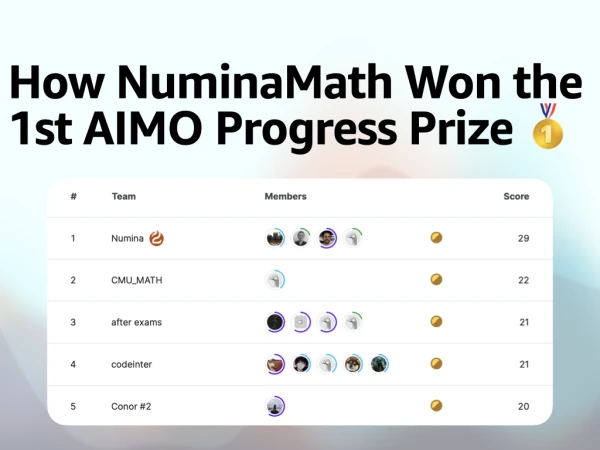
A team of mathematicians and AI researchers, known as NuminaMath, has won the first AIMO Progress Prize, a competition designed to accelerate progress in automated mathematical reasoning. The prize, awarded by the AI Mathematical Olympiad (AIMO) foundation, recognizes breakthroughs in AI systems that can solve complex mathematical problems.
The NuminaMath team, composed of experts from academia and industry, developed a novel approach that combines neural networks with symbolic reasoning engines. Their system was able to solve a set of challenging problems from the International Mathematical Olympiad (IMO) with unprecedented accuracy.
"This achievement marks a significant milestone in the quest for AI that can think like a mathematician," said Dr. Elena Vasquez, lead researcher of the team. "Our method not only solves problems but also generates human-readable proofs, which opens up new possibilities for education and research."
The AIMO Progress Prize was established to spur innovation in AI-driven mathematics, with the ultimate goal of creating systems that can outperform humans in mathematical contests. The NuminaMath team's victory highlights the rapid progress being made in this field. They will receive a $500,000 prize to further their research.
"What NuminaMath has accomplished is truly remarkable," commented AIMO chairperson Dr. James Liu. "They have demonstrated that AI can not only compute answers but also understand the underlying structures of mathematics."
The team's approach involved training a large language model on a vast corpus of mathematical texts and then fine-tuning it with reinforcement learning from proof-checking algorithms. This hybrid methodology allowed the system to both generate conjectures and verify their correctness.
Moving forward, NuminaMath plans to open-source their models and collaborate with math educators to create interactive learning tools. Their success has already sparked interest from tech companies looking to apply similar techniques to scientific discovery and engineering.